
The penal chapter, the supervision chapter and the ordinance
Two basic offences, one warning message and one card code
The penal chapter describes 2 basic offences: providing unlawful gambling, and promoting participation in it. Beside them sits a single measure aimed at a website, and a card-code rule that replaced a block applied zero times.
| Operator | Licence | Coins | Before ID check | Open |
|---|---|---|---|---|
| Rocketpot | Curacao | 13 | US$2,500 | Go to the casino siteRead |
| Bitcasino.io | Curaçao Gaming Authority | 12 | 2,500 EUR | Go to the casino siteRead |
| Wild Fortune | Anjouan Gaming Board | 10 | case by case | Go to the casino siteRead |
| DuckDice | Anjouan Gaming Board | 10 | case by case | Go to the casino siteRead |
| Empire.io | Anjouan Gaming Board | not read | 2,000 USDT | Go to the casino siteRead |
| Metaspins | Curaçao Gaming Authority | 9+ | case by case | Go to the casino siteRead |
| Rainbet | Anjouan Gaming Board | 9+ | case by case | Go to the casino siteRead |
| Wild.io | Curaçao Gaming Authority | 12 | case by case | Go to the casino siteRead |
| Wolf.bet | Government of the Autonomous Island of Anjouan, Union of Comoros | 32 | case by case | Go to the casino siteRead |


The two basic offences, word for word
Spellagen (2018:1138), the Swedish Gambling Act, entered into force on 1 January 2019 and replaced the earlier Lotteries Act and Casinos Act. The text we worked from is the consolidated wording under SFS 2026:90, in force since 1 May 2026.
The first section of the penal chapter reads:
1 § A person who intentionally or through gross negligence provides unlawful gambling or gambling without the licence required under this Act shall be sentenced for unlawful gambling operations to a fine or imprisonment for at most two years. In petty cases no liability is imposed.
The second section reads:
2 § A person who intentionally or through gross negligence promotes participation in gambling of the kind referred to in section 1 shall be sentenced for promotion of unlawful gambling to a fine or imprisonment for at most two years.
Two verbs carry the whole chapter: provide and promote. The first is the operator’s act. The second is the act of anyone who helps others take part, which is to say comparison sites and payment intermediaries.
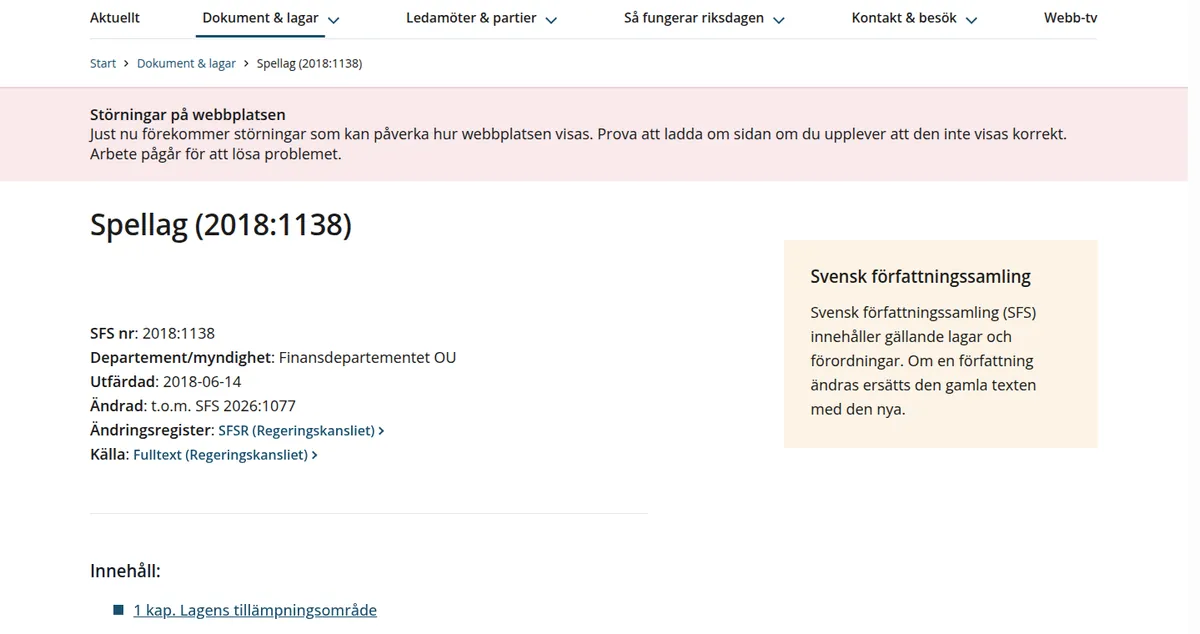
The text we worked from is the consolidated wording under SFS 2026:90, in force since 1 May 2026. This is where Chapter 19 on unlawful gambling operations sits, together with 14 kap. 12 § on self-exclusion and the two repealed sections in Chapter 18.
What the rest of the chapter contains
Section 3 takes the same two acts in their gross form and raises the scale to imprisonment for at least six months and at most six years. Sections 4 and 5 deal with match manipulation, that is, with rigged outcomes. Section 6 penalises attempts. Sections 8 and 9 govern seizure and forfeiture of equipment and proceeds.
Alongside the criminal penalty sits the financial penalty under 19 kap. 10 § and the sections that follow, imposed by the authority on anyone carrying on business contrary to the Act.
Two expressions decide liability: intent and gross negligence
Read the two quoted sentences again and stop at what comes before the verbs. Both sections require intent or gross negligence. Ordinary negligence therefore falls short under either provision, and that is an unusually high threshold for a penal provision in a regulated trade.
There is a second qualification that appears in only one of the two places. Section 1 ends with the sentence “In petty cases no liability is imposed.” Section 2, the promotion offence, lacks an equivalent sentence entirely. Formally, that means the petty-case exception is written for whoever provides the gambling rather than for whoever promotes it, even though the penalty scale is identical.
We leave open how the courts apply the difference, because we have read zero judgments. What is set out here is what the two sentences contain, and what one of them contains that the other lacks.
Section 1 describes two cases rather than one
A third word in the same sentence is easy to read past. Section 1 speaks of a person who provides unlawful gambling or gambling without the required licence. Those are two alternatives joined by “or”, which makes them two separate acts under one heading.
The distinction is real. A game can be unlawful in itself, whoever offers it, and a game can be lawful in itself but be offered by someone lacking the required permit. The second case is the one that applies to the operators this site deals with, and the first case is a different matter.
Section 2 then hangs off section 1 through the words “gambling of the kind referred to in section 1”. The promotion offence therefore inherits both alternatives, and the reach of section 2 cannot be narrower than the reach of section 1.
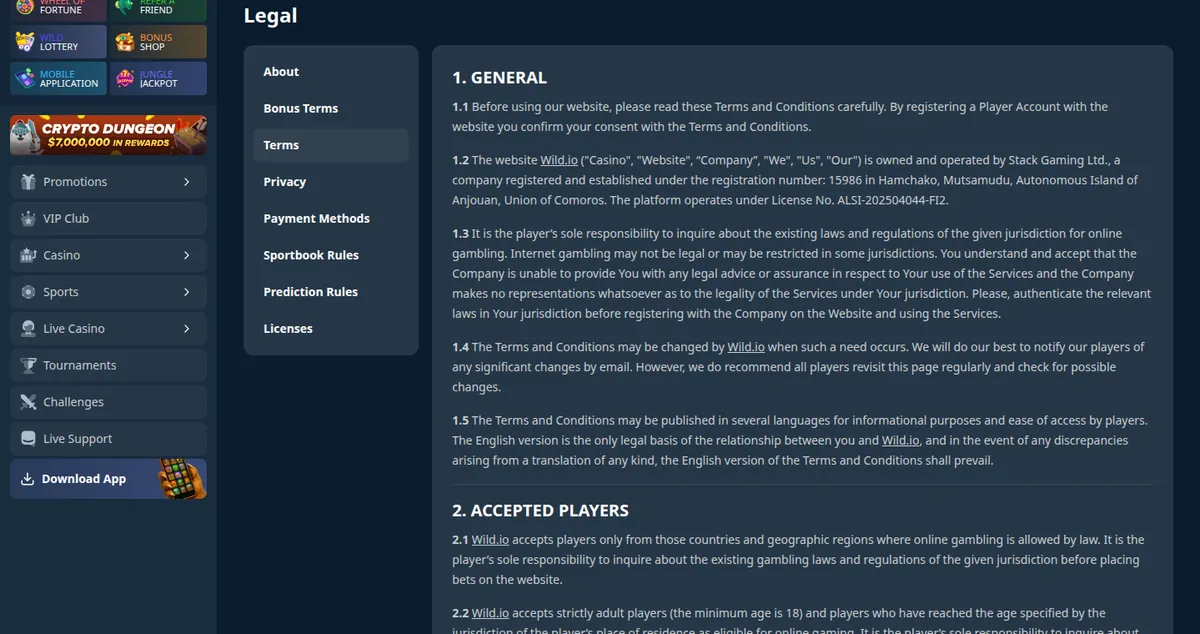
This is where the withdrawal cap of 100,000 USD per week in clause 9.6 comes from. We found the permit number OGL/2024/210/0198 in the Curaçao certificate register, and the company on the permit is Nonce Gaming B.V.
The person who stakes money goes unmentioned in the chapter
None of the offence descriptions above reaches the person placing a stake. Promotion under section 2 is an accessory offence: it presupposes that somebody else takes part, and the person taking part is therefore someone other than the person promoting.
This is a reading of what the words in the chapter cover. It falls short of a statement that unlicensed gambling is risk free, and it says nothing about tax, about contractual disputes or about what happens when an operator refuses to pay out. Those questions are settled elsewhere than in the penal chapter, and the tax question has a chain of sections of its own on the page about tax on winnings.
On its own page about illegal gambling, Spelinspektionen writes that gambling directed at Sweden without a licence is illegal and that providing or promoting such gambling is prohibited. About the player’s own position the authority says nothing. That silence cannot be read in either direction, which is why the statutory text stands here rather than the authority’s summary.
The only measure aimed at a website
18 kap. 28 § of spellagen reads:
Where there are special reasons, the gambling authority may order an internet service provider to put in place a warning message that is clearly displayed in connection with visits to a website that provides gambling without the licence required under this Act.
Read what the order covers. The internet service provider is to put in place a message displayed in connection with the visit. The address stays in the name system, the traffic keeps flowing and the visit goes ahead. The box is the measure. The provision was reconsidered in government bill 2022/23:33, and the conclusion was that the rules on warning messages should stand unchanged.
Whether the section has ever been applied is something we have been unable to check. We found nothing, and we have left the authority unasked. It stands here as a gap rather than as a claim in either direction.
We have read Chapter 18 in its current wording and find nothing on removing a domain, stopping traffic to an IP address or forcing a redirect. Norway and Denmark keep registers of blocked addresses; Swedish law lacks a counterpart. A site being hard to reach therefore means something different here than in the neighbouring countries.
The payment block that was removed without being used
The power to block payments sat in 18 kap. 26–27 §§. The authority could apply to the administrative court for an order against a payment service provider to block transfers to and from an unlicensed gambling operator.
In the current wording, a single line stands in both places instead: “26 § Repealed by lag (2023:309)”, and the same for section 27. The amendment has applied since 1 July 2023.
The reason is in the preparatory work, government bill 2022/23:33: the authority had found the provisions difficult to use, and LeoVegas raised precisely that point in the consultation round. They were removed without ever having led to a block. A general ban on payment intermediation was considered in the same process and left out.
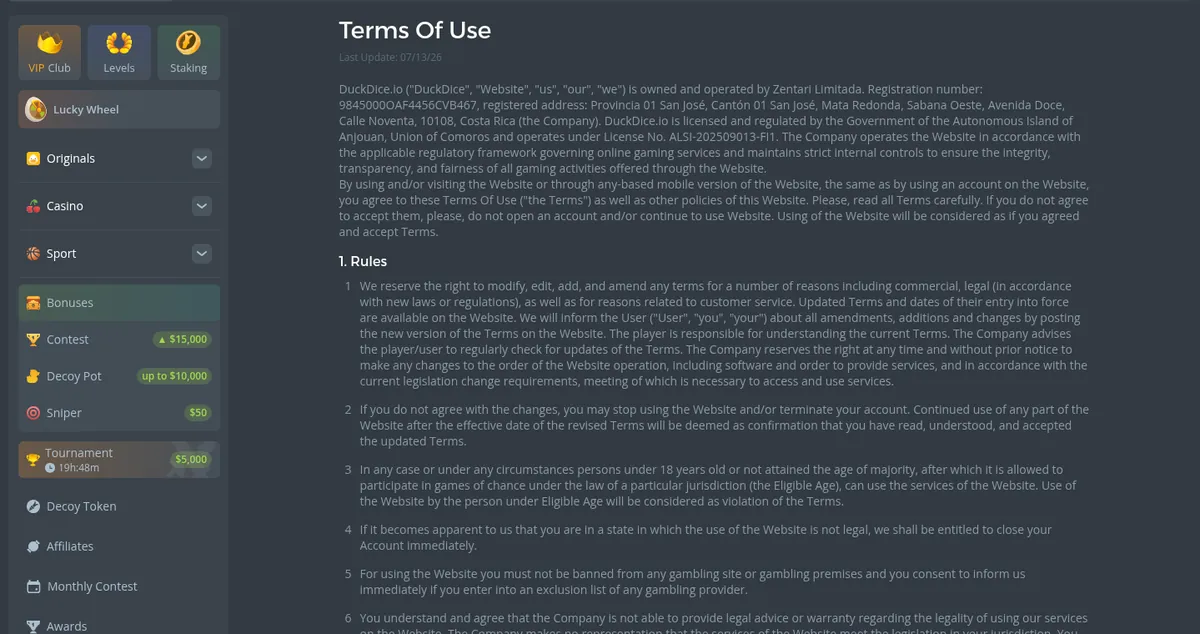
Section 2 frames verification as a judgement call: documents may be requested, with no amount named. The permit ALSI-202509013-FI1 appears in the public Anjouan register under Zentari Limitada, and the coin list runs to ten entries.
Section 2 frames verification as a judgement call: documents may be requested, with no amount named. The permit ALSI-202509013-FI1 appears in the public Anjouan register under Zentari Limitada, and the coin list runs to ten entries.
The rule that applies instead, word for word
It sits in spelförordningen (2018:1475), the Gambling Ordinance, rather than in the Act, at 13 kap. 1 §, under the heading Payment blocking. It was introduced by förordning (2023:310) and reads:
Payment service providers under the Payment Services Act (2010:751) shall refuse payment orders where a payment card is used and authorisation takes place through the use of the merchant category code (MCC) 7995. The obligation to refuse payment orders does not apply where the payment order concerns a business that holds a licence under the Gambling Act (2018:1138) or where such a licence is not required.
Three things separate this rule from the one that was removed. A court is uninvolved: the refusal happens automatically at the payment service provider. It bites on a merchant category code rather than on a company, that is, the trade code the transaction is authorised under. And it has an express exception for businesses that hold a licence or need none.
What the rule leaves out follows from its own wording: it concerns payment orders where a payment card is used. The two Swedish payment routes most often drawn into the same argument fall outside card payments, and what excludes them instead is set out on the pages about Swish and Trustly.
The two sections drafted without a card in them
Around the card-code rule sit 13 kap. 1 a–1 c §§, and they work differently. The first obliges a payment service provider, at the request of Spelinspektionen, to hand over available information on account numbers, names, merchant IDs and acquirer IDs used in transmitting stakes or winnings to or from a gambling business without the required licence. Account numbers are named before merchant IDs, and every part of the sentence works without a card.
The third obliges the authority to keep payment service providers informed of injunctions and prohibitions under 18 kap. 23 § against companies that provide gambling without the required licence or that provide payment solutions for the gambling industry. A payment institution can therefore itself be the addressee of an injunction.
That is a channel for information and a duty to inform, rather than a decision about an individual payment. We have left unmeasured how often the code is actually attached to a transaction, and we therefore claim nothing about how many payments are stopped.
The authority’s other instruments
The toolbox is aimed at the business rather than at the route to it. Injunctions and prohibitions under 18 kap. 23–25 §§ may carry a conditional fine. Financial penalties are imposed on whoever breaches the Act. Since 1 July 2023 the authority may also make undercover test purchases, that is, buy anonymously in order to see how an operator behaves towards a customer.
What all three have in common is the addressee: the operator, or whoever promotes its gambling. What a licence compels an operator to do in return, section by section, is on the page about online casinos.
Why something else is often written instead
The formula that since 2023 the authority has used both domain blocking and payment blocking recurs on several Swedish pages dealing with this question. The year is right, but the direction is reversed: 2023 is the year the court-ordered block was removed.
The phrase “illegal gambling” also stops short of making every person involved an offender. A prohibition can be aimed at one party in a two-party relationship, and Chapter 19 is drafted that way. We have found zero Swedish sources giving a section number for the claim that the player is punished. If we have missed a provision we will correct the page and set out what changed, under the routine on the page about how we read the documents.
An ongoing review we have left unread
A review of parts of the gambling regulation sits in the ministry publications series as Ds 2025:23. We have left it unread, and we therefore reproduce nothing from it: its proposals, its rejections and its timing alike.
The reason for mentioning it anyway is that a page describing the law as it stands ought to say where the text may age. Everything above was read in the consolidated wording on 1 September 2026, and that wording is the result of several amendments over five years — the 2023 changes removed two sections and added one provision to the ordinance.
We therefore claim nothing about legislative movement during 2026. If anything changes we will correct the page and set out what changed and when, under the routine on the page about how we read the documents.
The sections on this page were read on 1 September 2026. What the statute leaves unregulated is the contract terms: withdrawal caps, verification thresholds and processing times differ from operator to operator and are set out on the page about identity checks and withdrawals.