
The section that draws the line
The exclusion binds licensees, and stops there
An exclusion registered until further notice cannot be lifted for 12 months. The same section also says at whom it applies, and that sentence is the most important qualification on this whole site.
| Operator | Licence | Coins | Before ID check | Open |
|---|---|---|---|---|
| Rocketpot | Curacao | 13 | US$2,500 | Go to the casino siteRead |
| Bitcasino.io | Curaçao Gaming Authority | 12 | 2,500 EUR | Go to the casino siteRead |
| Wild Fortune | Anjouan Gaming Board | 10 | case by case | Go to the casino siteRead |
| DuckDice | Anjouan Gaming Board | 10 | case by case | Go to the casino siteRead |
| Empire.io | Anjouan Gaming Board | not read | 2,000 USDT | Go to the casino siteRead |
| Metaspins | Curaçao Gaming Authority | 9+ | case by case | Go to the casino siteRead |
| Rainbet | Anjouan Gaming Board | 9+ | case by case | Go to the casino siteRead |
| Wild.io | Curaçao Gaming Authority | 12 | case by case | Go to the casino siteRead |
| Wolf.bet | Government of the Autonomous Island of Anjouan, Union of Comoros | 32 | case by case | Go to the casino siteRead |


The basis, word for word
Spelpaus, the Swedish national self-exclusion scheme, rests on 14 kap. 12 § of spellagen:
A player shall be able, by notifying the gambling authority, to exclude themselves from all gambling requiring registration under 12 kap. 1 §. The exclusion shall apply at all licensees for a certain period or until further notice. An exclusion until further notice may not be lifted before twelve months have passed.
The register is kept by Spelinspektionen and registration is made at spelpaus.se. Three things sit in that single provision: what the exclusion covers, at whom it applies and how long it binds.
Free support on 020-81 91 00, with no ID required. Stödlinjen is run by Stockholms läns sjukvårdsområde with funding from the Public Health Agency of Sweden, which makes it a public service rather than an industry one.
The periods and the twelve-month rule
The periods are ten days, one month, three months, six months or until further notice. A period once begun cannot be broken off early, and until further notice means at least twelve months before the exclusion can even be lifted.
That a period cannot be shortened is a feature rather than a defect. The decision is taken once, in a calm moment, and then holds even on the days when one would have decided otherwise. That is the whole point of its sitting with a public authority rather than with each individual operator.
An exclusion once begun runs out when the period ends, and only then. The decision you made about yourself stands for the whole of that time, and Stödlinjen is there if the time feels long.
The sentence that settles the reach
The exclusion shall apply at all licensees. That is a provision about what licensees are obliged to do, that is, about who is bound by the register.
An operator without a Swedish licence falls outside the circle of licensees. The register therefore leaves it unbound, and a corresponding duty on anyone else to stop a game is missing outside that circle. This holds for all nine operators in the table whose licence we were able to read, and it holds just as much for the tenth, where such a detail eluded us entirely.
This is the heaviest qualification on the site and the reason it appears in the footer of every page. Writing that a protection is absent differs from describing it as available, and this site does the first rather than the second.
The bonus rule stops at exactly the same boundary
The exclusion register is one of two protective rules drafted about the licensee. 14 kap. 9 § reads:
A licensee may offer or grant a bonus only on the first occasion on which a player plays any of the licensee’s games.
Same words, same circle, same boundary. The two provisions are moreover connected in substance: one limits how often an operator may offer something extra, the other stops the operator offering anything at all to someone who has excluded themselves.
An operator outside the licensed circle escapes both. That is an observation about what the sections say and about whom they are written, and it holds equally for both. What other duties the licence brings with it is on the page about online casinos.
What the exclusion leaves out even at licensees
The section speaks of gambling requiring registration under 12 kap. 1 §. Gambling free of the registration requirement falls outside, and the exclusion therefore stops short of a complete block even inside the licensed circle.
That is worth knowing for anyone who assumes that one registration covers every form of gambling for money. The register is built around the registration requirement, and its reach follows that requirement exactly.
A misunderstanding about whom the section is aimed at
Another misunderstanding is that an exclusion would have legal effect against the player themselves. The penal provisions in Chapter 19 name whoever provides and whoever promotes the gambling; the wording is reproduced on the page about what the statute says. The exclusion is a duty on the operators rather than a sanction on the customer.
It also means the register lacks a counterpart in the tax rules, in the contract terms or in the supervision of payments. Each of those questions is settled by its own provisions.
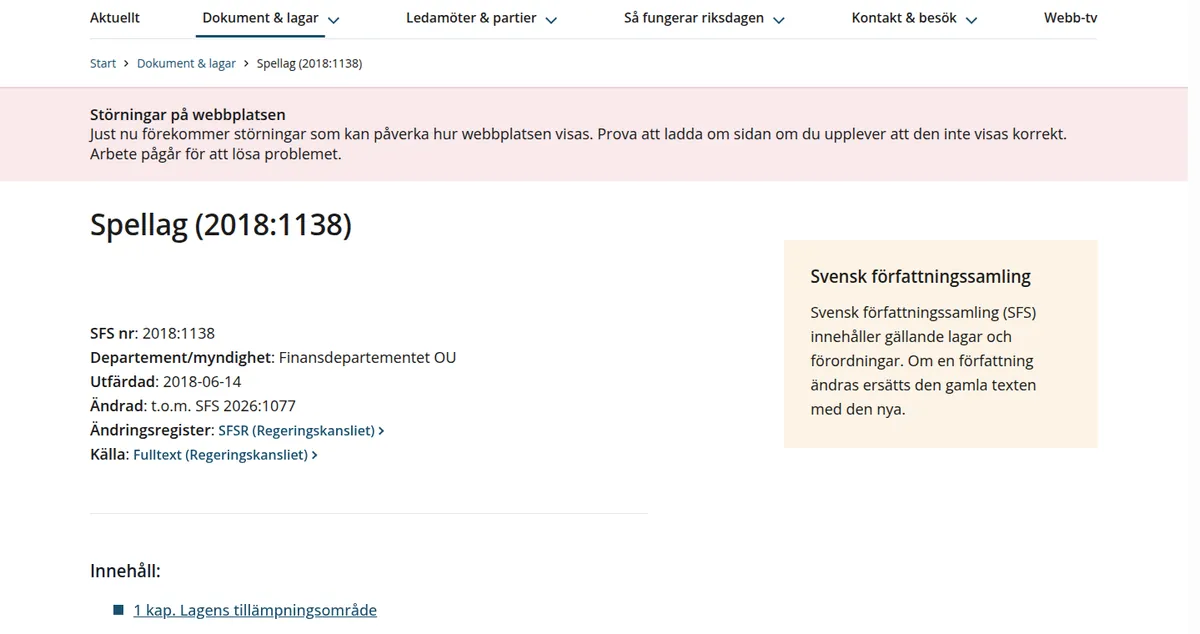
The text we worked from is the consolidated wording under SFS 2026:90, in force since 1 May 2026. This is where Chapter 19 on unlawful gambling operations sits, together with 14 kap. 12 § on self-exclusion and the two repealed sections in Chapter 18.
Where to get help, free of charge
Stödlinjen answers on 020–81 91 00. The call is free and requires nothing by way of identification. Opening hours are Monday 9–19, Tuesday 9–17, Wednesday 9–17, Thursday 11–19 and Friday 9–15, on weekdays other than public holidays. Support in Arabic is available on Thursdays 13–19, and English is available within the ordinary hours. Further languages can be arranged through an interpreter.
Stödlinjen is run by Stockholms läns sjukvårdsområde, the Stockholm regional health care provider, with funding from the Public Health Agency of Sweden. It is therefore a public service, unlike several helplines in neighbouring countries that are funded by gambling operators or by a state monopolist. Anyone calling is speaking to someone whose mandate comes from somewhere other than the industry.
What the ten operators' terms say about excluding yourself
Here the page has to say something uncomfortable about its own material.
Our fact base lacks a field for self-exclusion, and none of the notes we took from the ten sets of terms bears on the subject. We therefore cannot write that any of the operators offers a tool for excluding yourself, and we cannot write that any of them lacks one either.
The rule is the same as for every empty cell in the table: information that eluded us means the document went unread for that question. Something other than zero, and something other than a denial. The distinction matters more here than anywhere else on the site, because a wrong denial would discourage somebody from looking for a tool that exists, and a wrong assurance would promise a protection nobody has checked.
What can be said with a statutory provision behind it is how the two things differ at root. A register held by a public authority applies at every licensee simultaneously under 14 kap. 12 §, and a period once begun cannot be broken off early. A tool an individual operator builds into its own terms applies at that operator, is written by the operator and can be changed by the operator. The two are different kinds of thing, even when they have similar names.
The periods in hours and days
The periods can be set out as numbers, and then it becomes clear how the last one differs from the other four.
The four fixed periods are 10 days, 1 month, 3 months and 6 months — from ten days to half a year. The fifth, until further notice, binds under the final sentence of the section for at least twelve months before it can even be lifted. A year is twice as long as the longest fixed period, and it is moreover only the earliest point at which the exclusion can be lifted; it stays in force until lifted.
Stödlinjen’s opening hours can be counted the same way. Monday 9–19 is ten hours, Tuesday and Wednesday 9–17 are eight hours each, Thursday 11–19 eight hours and Friday 9–15 six hours. That comes to forty hours a week, on weekdays other than public holidays, with zero opening hours on Saturday and Sunday. Support in Arabic sits within Thursday’s hours, from 13 to 19, that is, six of the forty.
The number is 020–81 91 00, the call is free and identification is unnecessary.
Where the register ends and the contract begins
Outside the licensed circle a provision that stops a game is missing, and what exists instead is whatever the operator has written itself.
That is worth holding together with what the verification clauses look like. Six of the ten write that documents may be requested whenever the operator considers it necessary, lacking both amount and deadline; three state an amount with a clause number. A wording of the first kind commits the operator to nothing, and anyone wanting to know where the boundaries lie is left to read what stands in its place — which is exactly what the page about identity checks and withdrawals does clause by clause.
The same holds in the other direction. Four operators publish a cap on withdrawals, set by the operator. None of the ten sets of terms mentions a limit on deposits set by the customer, the tool required by 14 kap. 7 § inside the licensed circle. The two instruments point different ways, and the difference is dealt with section by section on the page about online casinos.
If you are reading this before a deposit
Three checks take a quarter of an hour, and all three concern what is written down.
Read the verification clause in the terms, so that you know whether an amount exists or the operator decides for itself. Three of ten state an amount with a clause number, six write that they decide case by case, and the difference is set out on the page about identity checks and withdrawals.
Read the withdrawal clause, because a weekly cap and a monthly cap give entirely different outcomes for the same sum. Four operators publish such a cap, in three different currencies.
And search the country list for Sweden and SE: eight of the 38 lists we read contain Sweden, which is described on the page about offshore operators. What a permit number proves, and where it stops, is on the page about offshore licences.
When this was read
The sections on this page were read on 1 September 2026 in the consolidated wording under SFS 2026:90. The periods and the twelve-month rule were taken from spelpaus.se the same day, and Stödlinjen’s opening hours from stodlinjen.se.
If any of the details change we will correct the page and set out what changed and when, under the routine on the page about how we read the documents.