
Short answers, with a reference
Twenty-five questions, answered with a section or a clause number
25 questions that recur in the search results for this subject. Every answer has a statutory section, a clause in the terms or a count behind it, and 4 of the questions are answered by saying the material is missing.
Is it illegal to offer gambling in Sweden without a licence?
Yes. 19 kap. 1 § of spellagen calls it unlawful gambling operations and sets the penalty at a fine or imprisonment for at most two years. Section 2 penalises whoever promotes participation in such gambling, on the same scale. Section 3 raises the scale for the gross offence to imprisonment for at least six months and at most six years.
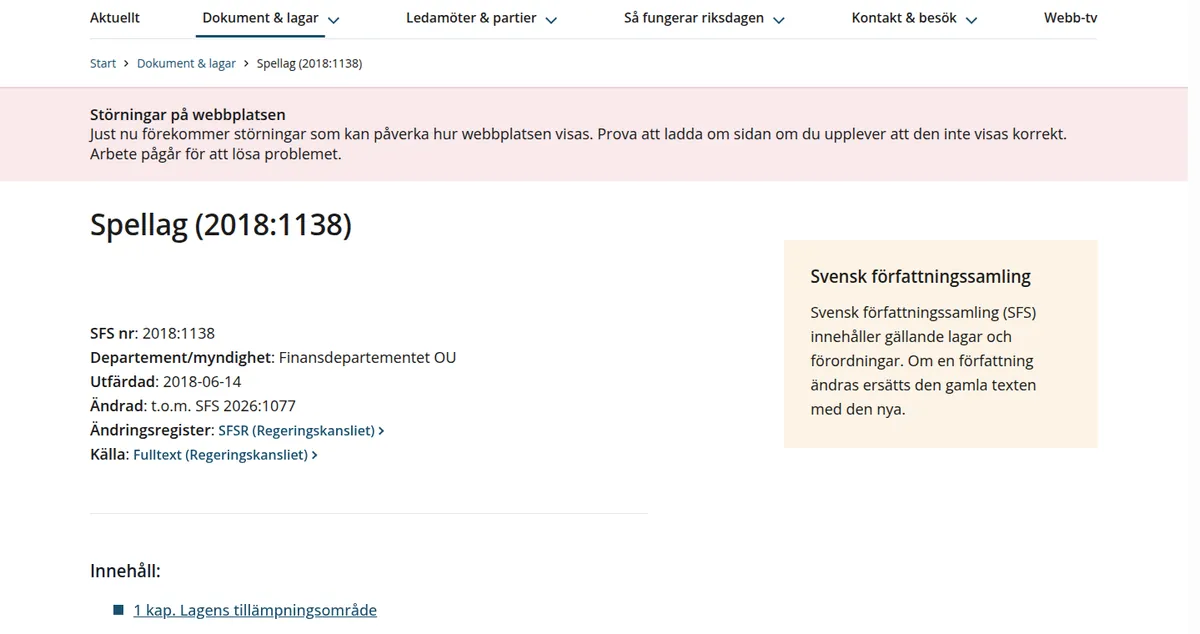
The text we worked from is the consolidated wording under SFS 2026:90, in force since 1 May 2026. This is where Chapter 19 on unlawful gambling operations sits, together with 14 kap. 12 § on self-exclusion and the two repealed sections in Chapter 18.
Does the penal chapter mention the person who stakes money?
No. The offence descriptions in the chapter speak of providing and of promoting. There is no provision aimed at the person placing a stake, and the whole text is reproduced on the page about what the statute says. That is a reading of the words rather than a statement that anything is risk free.
Does Sweden block domains leading to gambling sites?
No. Swedish law contains no provision on removing a domain or stopping traffic. The only measure aimed at a website is the warning message in 18 kap. 28 §, under which the internet service provider is ordered to display a box of text in connection with the visit. Whether the section has ever been applied we have not been able to check.
Are payments to unlicensed operators blocked?
Partly, and not in the way usually described. The court-ordered block in 18 kap. 26–27 §§ was repealed on 1 July 2023 without ever having been used. What remains is an automatic refusal of card purchases authorised under code MCC 7995, under 13 kap. 1 § of the Gambling Ordinance. The ordinance text is reproduced in full on the page about what the statute says.
Does Spelpaus apply at operators without a Swedish licence?
No. 14 kap. 12 § says the exclusion shall apply at every licensee, and an unlicensed gambling operator is not a licensee. The protection therefore does not travel with you, and that is the most important limitation on this whole site. Anyone who wants to talk to somebody about their gambling can reach Stödlinjen free of charge on 020–81 91 00, and available without identification. More on the reach on the page about how far Spelpaus reaches.
Why may a Swedish operator give a bonus only once?
Because 14 kap. 9 § says so: a licensee may offer or grant a bonus only on the first occasion on which a player plays any of the licensee’s games. The rule is drafted about the licensee, exactly as the exclusion register is, and both therefore stop at the same boundary. What other duties the licence brings with it is on the page about online casinos.
What does a permit number from Curaçao or Anjouan mean?
That an authority there has assessed the business against its own rules. It leaves the gambling unlicensed under spellagen. Seven of the nine numbers in our table could be found in the issuer’s register; two appeared only in the operator’s own documents, which we go through on the page about offshore licences.
Why does the site show a different number from the register?
It happens in four of the nine cases. For Wild.io and Metaspins the explanation is that they hold two permits, one in each jurisdiction, with a different company name on each. Wild Fortune writes a short number on its site and has a longer one in the Anjouan register, and Bitcasino.io gives one number on the front page and another in its anti-money-laundering policy. None of the discrepancies proves anything in itself — but somebody who tries one of two numbers and gets no hit has not shown anything.
Do I have to identify myself?
The terms settle that, not the statute. Three of ten operators state an amount with a clause number: 2,500 USD, 2,500 EUR and 2,000 USDT respectively. Six write that they request documents whenever they consider it necessary. One operator, Wild Fortune, writes the opposite: identification must be supplied before play begins. The differences are dealt with on the page about identity checks and withdrawals.
Is there a cap on how much I can withdraw?
At four of ten, with amount, period and clause number, and none of the caps is set in kronor. The other six publish no figure, which we record as a gap and never as an unlimited cap. Two of the four caps are moreover drafted more narrowly than they look: Rocketpot’s clause applies only to winnings from 5,000 dollars, and Wild.io has both a seven-day and a thirty-day cap.
How is a win from an unlicensed operator taxed?
That is settled by 8 kap. 3 § of the Income Tax Act. The win is tax free where, among other cases, the gambling is provided in a state within the EEA and the gambling does not require a licence in Sweden — two conditions at once. If it is not tax free, 42 kap. 25 § requires it to be declared above 100 kronor, computed net per gambling provider and tax year, and the rate is 30 per cent under 65 kap. 7 §. The sections appear word for word on the page about tax on winnings. The assessment in an individual case is made by Skatteverket, and this is not tax advice.
Can I pay with Swish or Trustly?
Our material lacks a field for payment methods, and none of the notes from the ten sets of terms mentions either. What can be documented sits on the other side of the transaction: Nordea’s general terms for Swish Handel prohibit the customer in clause 8 from supplying gambling through the service where the necessary Swedish permits are lacking, which is set out on the page about Swish. Trustly is a payment institution in the company register of Finansinspektionen with five permissions, and what that means is on the page about Trustly.
What do the operators' own terms say about the payment route?
Four of them say something quotable. Metaspins writes in clause 12.5 that the maximum withdrawal amount may be limited depending on the payment method chosen. DuckDice keeps a separate country list for card withdrawals in fiat, distinct from the account’s blocking list. Wild Fortune leaves the maximum per method unstated and lists its monthly cap in six currencies, none of them Swedish kronor. And Bitcasino.io’s box labelled Payment methods contained only the exchange rate 1 USDT = 1 USD.
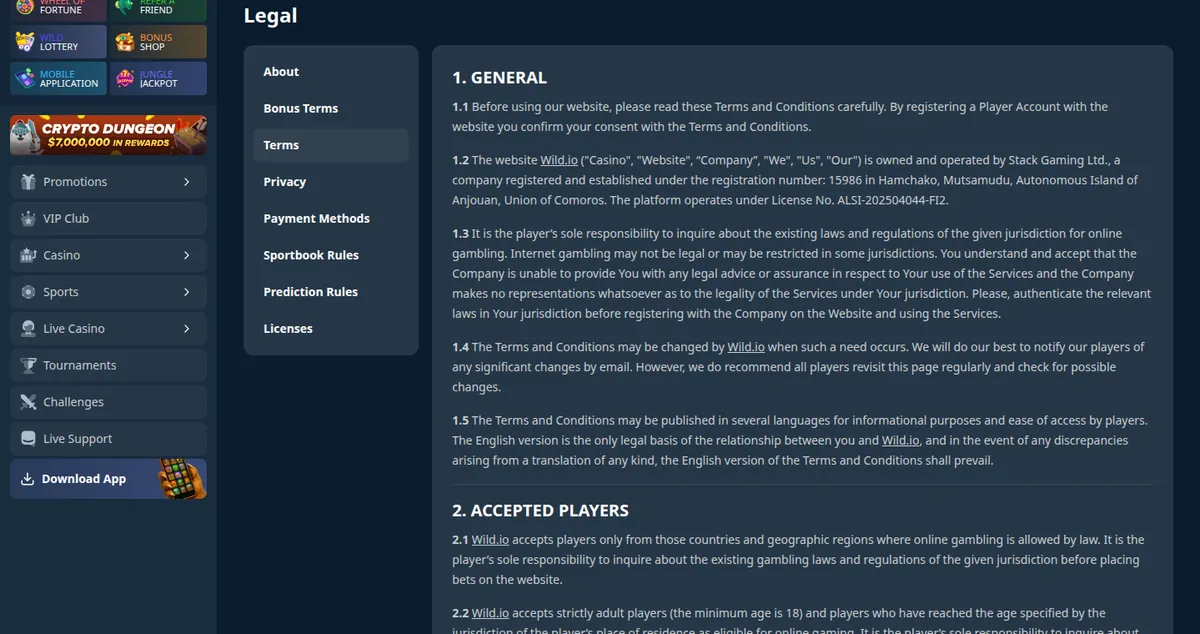
This is where the withdrawal cap of 100,000 USD per week in clause 9.6 comes from. We found the permit number OGL/2024/210/0198 in the Curaçao certificate register, and the company on the permit is Nonce Gaming B.V.
What is the minimum deposit at the ten operators?
That information is missing from our material. We have read licences, coin lists, verification clauses and withdrawal caps, and none of the four contains a minimum deposit amount. An answer in euros or kronor would therefore come from somebody else’s summary, and we leave those unquoted. What can be said about small amounts is on the page about minimum deposits.
How do I tell whether an operator is new?
By the issue date in the permit register rather than by the year in the footer. Nine permits in the table carry such a date, the freshest from 30 June 2026 and the oldest from 28 May 2024. All nine appear with company name and validity period on the page about new casinos.
Which of the ten is best?
We name none. What we can count is how much each operator puts in writing — eight checks summed to ten points — and how many game suppliers its own list names. Both measures, and the three things often ranked but impossible to rank, are on the page about the measure behind a top list.
How unusual is it for an operator to spell out a threshold?
Very unusual. Our material holds 100 operators, and five of them state an amount: Empire.io 2,000 USDT, Bitcasino.io 2,500 EUR, Rocketpot 2,500 USD, Sportsbet.io 2,500 EUR and Livecasino.io 2,500 EUR. A further 21 cite a clause number without a figure. The remaining 74 describe a judgement call lacking both amount and clause. An operator lacking a published threshold is therefore the rule in the material and says nothing particular about that operator. The count is on the page about identity checks and withdrawals.
How long do I have to send the documents in?
Only one of the ten operators spells it out. Rocketpot’s terms give 30 calendar days for requested documents on identity and source of funds. The other nine contain no deadline at all, either for your submission or for the operator’s handling. A deadline that is not written down may still be applied, and one that is written down can at least be used to hold somebody to it.
How many publish a cap on withdrawals?
Four of ten in the table and fourteen of the hundred in the material. The caps are stated in euros, dollars and USDT; six are counted per week, five per month, two per day and one per individual transaction. None of the fourteen is stated in Swedish kronor, and why that matters is taken up on the page about Swish.
Which countries do the operators exclude most often?
Of the 38 country lists we could read in full, the United States appears on 32 and the United Kingdom on 29. Within the EEA the Netherlands is highest with 27 lists, followed by Spain on 24, France on 23 and Lithuania on 19. A country recurring on two thirds of the lists is hardly excluded for reasons specific to any one operator.
What does it look like for Sweden’s neighbours?
Sweden appears on 8 of the 38 lists, Iceland on 7, Denmark on 2, Finland on 1 and Norway on none at all. That Norway is absent entirely despite a monopoly regime and blocked addresses shows that a country list is a commercial decision rather than a reflection of the legal position; the comparison is on the page about offshore operators.
Which game suppliers recur everywhere?
Six of the ten publish a list, and between them they name 182 distinct suppliers. Six names appear on all six lists: BGaming, PG Soft, Pragmatic Play, Spinomenal, Evolution and Hacksaw. Almost half the names, 85 of them, appear on only one list. The difference between a short and a long list therefore lies almost entirely in the tail rather than in the core.
What happens when a permit expires?
We do not know, and we predict nothing. Two of the permits in the table expire shortly after publication: DuckDice’s on 15 September 2026 and Wild Fortune’s on 29 September 2026. A permit that expires is usually renewed with a new issue date, but what happens in those two cases appears in none of the documents we read. The dates and the register entries are on the page about new casinos.
Do the operators offer any way to exclude yourself?
That is not in our material, and we therefore answer neither yes nor no. None of the notes from the ten sets of terms bears on the subject, which means the documents were not read for that question — never that the tool is absent. What the statute does say is that the exclusion under 14 kap. 12 § applies at every licensee and stops there, which is developed on the page about how far Spelpaus reaches.
Have you played at the operators in the table?
No. This site holds no account with any of them and has not deposited a krona. Every figure comes from a document the operator or an authority publishes, read on a stated date. The routine, including how we correct when we have been wrong, is dealt with on the page about how we read the documents. Which operators exclude Swedish customers themselves is listed on the page with the eight country lists.