
Method and limitations
What this site does, and where it stops
The site is built on 2 kinds of document: statutory text in its current wording, and the operators' own terms. Every figure comes from a statute or from an operator’s own document, and none comes from gambling of our own.
Which sources we read
Two kinds of document, and nothing else.
The first is statutory text in its current wording. Spellagen (2018:1138) we read in the consolidated text under SFS 2026:90, in force since 1 May 2026. Spelförordningen (2018:1475) we read the same way, and the reasoning behind the 2023 amendments in government bill 2022/23:33.
Besides the Gambling Act we read inkomstskattelagen (1999:1229) in the same form and Skatteverket’s own page about winnings from gambling and competitions. For the payment routes we read two banks' general terms for Swish Handel, published as PDFs by the banks themselves, and the company register of Finansinspektionen.
The second is the operators' own documents: the terms page, the cashier page, the anti-money-laundering policy and the permit detail, together with the issuer’s register where one exists to search. Every figure on these pages has either a section number or a clause number beside it, so that it can be looked up at the source.
We avoid quoting other comparison sites. A figure that has travelled between three such pages is impossible to trace back to a document, and that kind of travel is commoner in this subject than one would think.
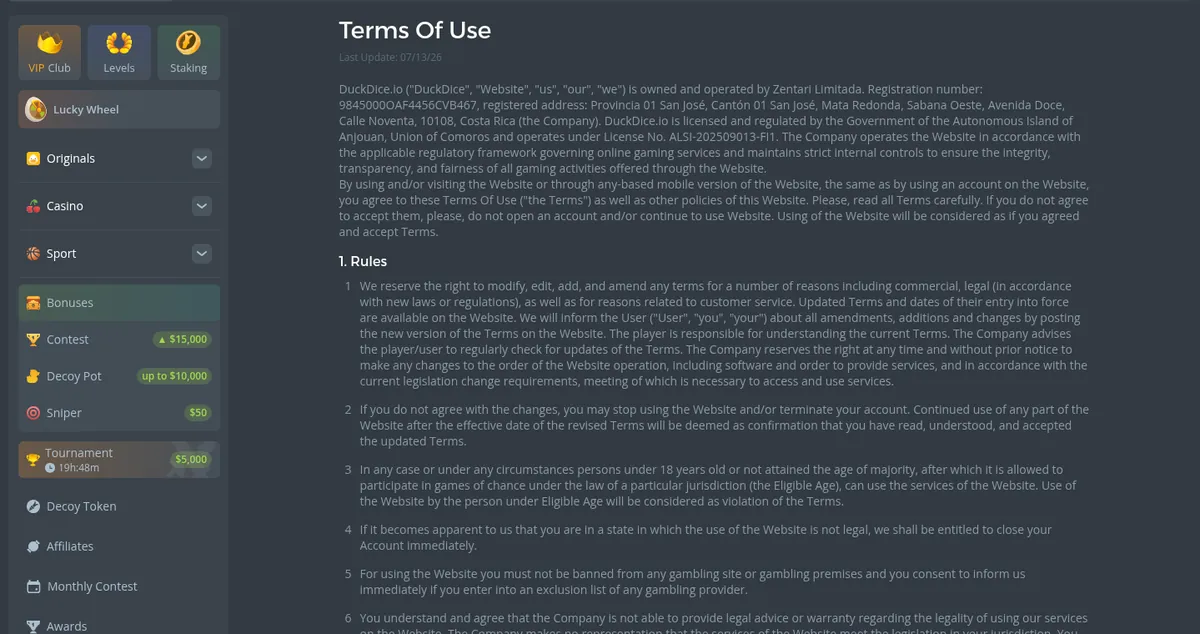
Section 2 frames verification as a judgement call: documents may be requested, with no amount named. The permit ALSI-202509013-FI1 appears in the public Anjouan register under Zentari Limitada, and the coin list runs to ten entries.
Dates, and why they are stated
The statutory text was read on 1 September 2026. The operators' terms were read on 26 August 2026.
Both change. A date separates a statement that was correct from one that is correct, and without a date there is nothing to tell you which of the two you are reading.
We also record how a text was obtained. A direct capture is a reading of what is up now; an archived copy may lag behind. One of the operators in the table and six of the eight on the page about offshore operators were read in an archived copy, and that is written out.
What an empty cell means
That the information eluded us. Something other than zero, something other than an open limit, something other than unrestricted.
The rule exists because the difference has consequences. A withdrawal cap left out of the terms may be applied anyway; a verification requirement lacking a published threshold can bite at any amount. Write the silence up as absence and the operator’s gap becomes the reader’s surprise, and that usually surfaces at the withdrawal.
One of the rows in the table is empty the whole way across. We refrain from filling it in from elsewhere, and the bar in the header is drawn only for the operators where there was material to read.
What the bars measure
Eight checks per operator, ten points. The checks are these: that the permit number exists, that it can be found at the issuer, that a company name is written out, that an amount for the identity check is published, that the clause number for it is given, that a withdrawal cap is published, that a coin list is published, and that the text could be captured directly. Two of them count twice: the permit number and the amount.
The bar therefore measures how much the operator puts in writing. It stays clear of judging the games, the payouts or the treatment of customers. An operator that publishes a lot can behave badly, and one that publishes little can behave well; we measure what can be checked. What the measure stretches to and where it stops is on the page about the measure behind a top list.
The difference between a quotation and a label of our own
Part of what appears in the table is transcribed from a document. Part is our summary of several pages. The two look alike in a cell while differing in kind, so we say which of them we have when it matters.
An example: three of the ten carry the tag crypto-only in our material. That tag is ours rather than the operator’s, and it rests on how the cashier and the terms looked at the time of reading. For a fourth operator we noted at the same time a route into fiat through an exchange service, which is exactly the kind of detail that makes such a label insufficient as evidence. The tag therefore stays as a summary and it is kept clear of any claim that a payment method is absent.
Contradictions are written out as contradictions
When two documents from the same operator say different things, we refrain from choosing on the reader’s behalf. We reproduce both and say that they differ.
Empire.io’s entry in the Anjouan register gives validity to a date that has already passed, while the status in the same entry stands as valid. Rocketpot’s terms give 2,500 USD in one clause and 2,000 USD in another. Bitcasino.io writes one permit number on the front page and another in its anti-money-laundering policy. Three of the operators moreover call their issuer different things on different pages.
The contradiction sits in the source rather than in the reading. Choosing one line over the other would add a judgement that lacks support in any document, and that is the same kind of addition as an invented figure.
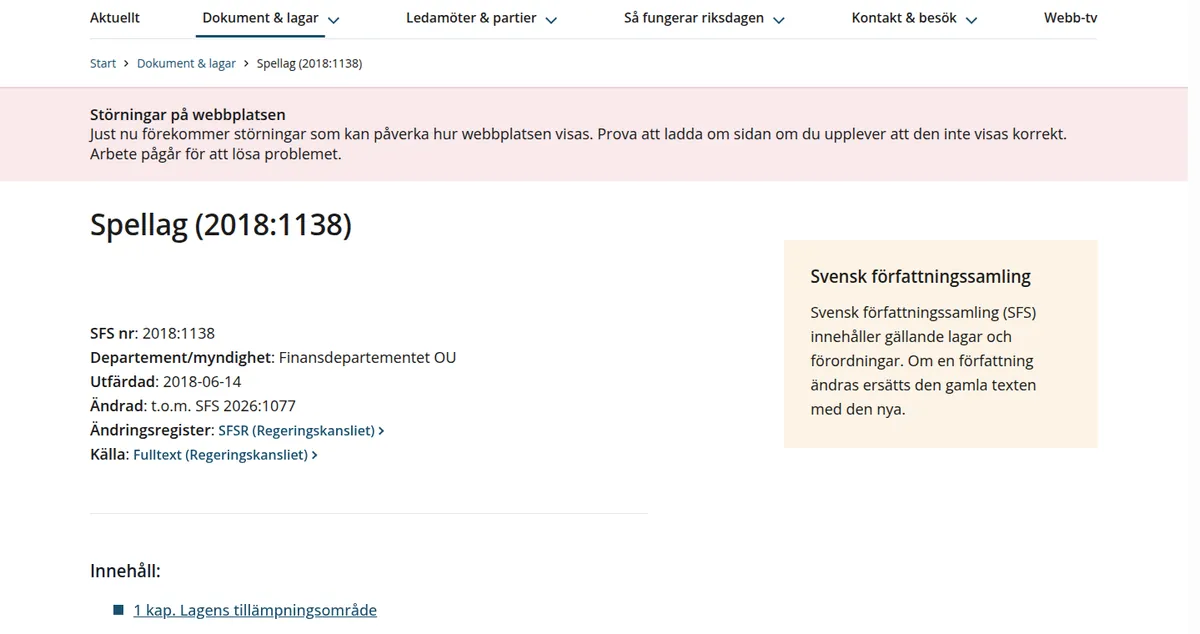
The text we worked from is the consolidated wording under SFS 2026:90, in force since 1 May 2026. This is where Chapter 19 on unlawful gambling operations sits, together with 14 kap. 12 § on self-exclusion and the two repealed sections in Chapter 18.
How large the material is, and how much of it is blank
The table shows ten rows. Behind them sits a collection of 100 operators, and how much of that collection is filled in is itself worth publishing.
- 67 of 100 name a permit issuer, 51 a company name on the permit.
- 38 of 100 have a country list that could be read in full.
- 29 of 100 publish a list of coins accepted.
- 26 of 100 cite a clause number for their verification wording, and 5 spell out an amount.
- 14 of 100 publish a cap on withdrawals.
- 11 of 100 state a founding year.
The captures break down into 37 direct readings, 41 archived copies and 22 entries where nothing readable turned up. Rather more than a fifth of the collection is therefore blank, and those rows stay empty.
We publish these numbers for the same reason that we publish an empty cell. A method that reports only what could be read conceals how much stayed unread, and that proportion is the best answer to the question of what an individual row is worth.
The numbers have a second function too. They make it possible to see how unusual an item is before drawing conclusions from its absence: a published threshold exists at five out of a hundred, so an operator lacking one is the rule in the material rather than a sign of anything about that operator.
What we have asked nobody
Nobody on this site has contacted any of the operators, any bank, Spelinspektionen or Skatteverket. We have requested nothing and asked nothing.
Everything here is therefore a reading of documents somebody else published: statutory text, an authority page, a company register, two banks' general terms and the operators' own terms pages. An answer from an authority or a support department would be a different kind of source, and when we eventually obtain one it will be stated beside the information.
That also covers questions we know readers ask and cannot answer. Whether an operator offers any tool for self-exclusion, for instance, is missing from our material, and we therefore leave the answer blank; the reasoning is on the page about how far Spelpaus reaches.
Three coincidences we have noted and left uninvestigated
Besides the contradictions above there are similarities between operators that we write out without drawing conclusions from them.
Three brands state the same amount in the same currency under the same clause number: Bitcasino.io, Sportsbet.io and Livecasino.io all write 2,500 EUR in clause 6.6. Three others, Oshi Casino, PlayAmo and Slotum, share a permit number and a company name — and still publish three different withdrawal caps: 4,000 euros per day, 7,500 euros per week and 15,000 in euros or dollars per week. And two brands, 7Bit Casino and Mirax, carry the same Curaçao number with different company names recorded.
Each of the three observations could mean several things, and which of them is right cannot be settled from the documents we have read. We report what is written and leave the question open rather than formulating an explanation that would become the site’s most quoted claim while resting on nothing.
What we leave alone
We stay away from gambling. This site lacks an account with every operator in the table and has deposited nothing, so every statement here rests on a document rather than on our own experience of play or payout.
We leave currencies unconverted. An amount in the terms stays in its own currency, because a contractual threshold differs from a price and the rate moves.
We leave unchecked the claims we can only read. Five of the operators state that they use provably fair; we have read that it is written down and have run zero verification algorithms. Calling a published claim a completed test is the same kind of error as calling an empty cell a zero.
Star ratings, countdowns and claims about how many people are looking right now are absent here. We do answer the tax question, but only by reproducing the sections and the authority’s own page, without computing anybody’s individual case; how far that reading stretches is on the page about tax on winnings. Other recurring questions are answered with a section or clause number on the page of questions and answers.
Where we stand, geographically
Our captures are made from a server in the Netherlands. A refused visit therefore says something about the Netherlands and nothing about Sweden, and we keep clear of writing that an operator shuts out Swedish customers on that basis. We make that claim only where it appears in the operator’s own terms.
For the same reason, nowhere here does it say that a given site can or cannot be reached from Sweden. We have left it unmeasured, and a measurement from the wrong country would be worse than none at all.
Corrections
If we find an error we change the page and write out what changed. A removed claim leaves a line behind it rather than a blank.
On 1 September 2026 the pages were rewritten from the ground up and merged into fewer and longer ones. Five pages ceased to exist as addresses of their own: the payment block and the site blocking now sit on the page about what the statute says, the licensee’s duties on the page about online casinos, the withdrawal caps together with verification on the page about identity checks and withdrawals, the country lists on the page about offshore operators and the coin lists with the payment routes. Every fact survived the move; anything lacking a source had been absent from the start.