
Clause numbers from the terms
Three operators name an amount, six decide case by case
Of 10 operators, three spell out the amount at which documents are requested, with a clause number. Four publish a cap on withdrawals. Both items sit in the same part of the terms and bear on the same money.
| Operator | Licence | Coins | Before ID check | Open |
|---|---|---|---|---|
| Rocketpot | Curacao | 13 | US$2,500 | Go to the casino siteRead |
| Bitcasino.io | Curaçao Gaming Authority | 12 | 2,500 EUR | Go to the casino siteRead |
| Wild Fortune | Anjouan Gaming Board | 10 | case by case | Go to the casino siteRead |
| DuckDice | Anjouan Gaming Board | 10 | case by case | Go to the casino siteRead |
| Empire.io | Anjouan Gaming Board | not read | 2,000 USDT | Go to the casino siteRead |
| Metaspins | Curaçao Gaming Authority | 9+ | case by case | Go to the casino siteRead |
| Rainbet | Anjouan Gaming Board | 9+ | case by case | Go to the casino siteRead |
| Wild.io | Curaçao Gaming Authority | 12 | case by case | Go to the casino siteRead |
| Wolf.bet | Government of the Autonomous Island of Anjouan, Union of Comoros | 32 | case by case | Go to the casino siteRead |


The three amounts, with clause and currency
Three operators in the table state a threshold in their terms. Rocketpot writes 2,500 USD in clause 11.4, Bitcasino.io 2,500 EUR in clause 6.6 and Empire.io 2,000 USDT in clause 5.4. The same clauses sit alongside the other terms of each operator in the comparison on the home page.
The amounts stay in the currency the terms use. We leave them unconverted into kronor, for two reasons: the exchange rate moves, and a threshold in a contract differs from a price. The operator applies its figure whatever the krona is doing that day.
Two of the three amounts look alike while differing in value. 2,500 EUR and 2,500 USD are different sums of money, and a table that writes both as a krona figure hides exactly that.
Note also how the sentences are built. Bitcasino.io writes that it reserves the right to carry out additional checks on withdrawals exceeding the amount, and Empire.io writes the same. A published threshold therefore marks the point at which an extra check is expressly to be expected, rather than a level that keeps checks away.
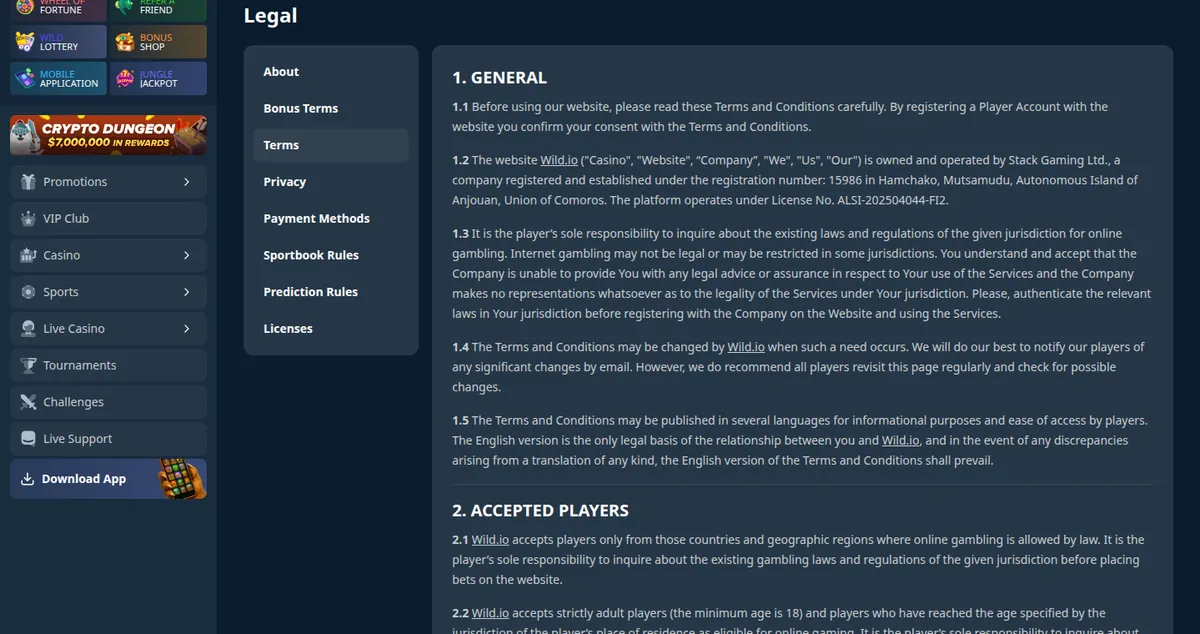
This is where the withdrawal cap of 100,000 USD per week in clause 9.6 comes from. We found the permit number OGL/2024/210/0198 in the Curaçao certificate register, and the company on the permit is Nonce Gaming B.V.
Rocketpot’s terms state two different amounts
The best-documented of the three thresholds is contradicted at another clause in the same document. Clause 11.4 speaks of withdrawals exceeding the equivalent of 0.05 BTC or 2,500 USD. Clause 12.4 instead speaks of additional checks for withdrawals over 2,000 USD.
We entered 2,500 USD in the table because it is the clause the operator itself points to, and we set out the other figure here rather than discarding it. The contradiction sits in the source rather than in our reading, and it is worth knowing about for a practical reason: the lower figure is the one that bites first.
The six that leave the amount unstated
Six operators describe a judgement call instead. Wild Fortune cites clause 18.1, Metaspins clause 9.7, Rainbet clauses 5.2 and 8.3, DuckDice section 2 and Wolf.bet its section on customer due diligence. At Wild.io we found the wording but failed to find a clause number to cite.
The effect is the same in each: documents may be requested, and the timing is for the operator to decide. A threshold to plan around is therefore missing, upwards as well as downwards. Metaspins' formulation is the clearest illustration — the terms say identity must be verified once play reaches a certain level, without ever writing which.
It is worth turning that round. A published threshold is information that ties the operator to a figure. An open-ended wording ties it to nothing, and it can just as easily bite at the first withdrawal as at the thirtieth. Wolf.bet’s help pages add that the check is required by law for large withdrawals, without saying what large means.
One operator puts the check before play
Wild Fortune is the exception that shows how wide the range is. Its terms say that players depositing in coin — the text says bitcoin — must submit valid identification before playing, and that deposits and stakes are held back until the check is complete.
That is a different order from the one the other nine describe, and it resembles the order that applies inside the licensed circle: 12 kap. 4 § of spellagen says play must wait until identity has been established. The difference is that at Wild Fortune it is a contract term the operator wrote itself and can change, whereas at a licensee it is a statutory provision. What duties the licence otherwise brings with it is on the page about online casinos.
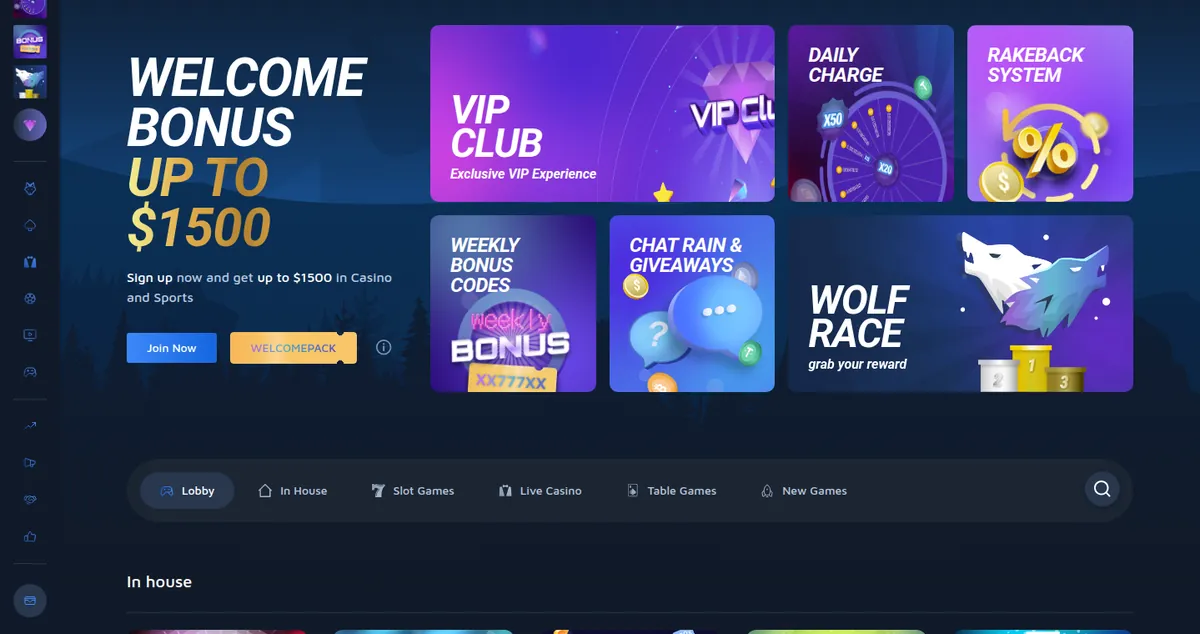
One of the two longest coin lists in the table: thirteen coins, with usdt and usdc among the six given prominence. We read the permit number ALSI-132405048-FI3 here, on the operator’s own page rather than in the Anjouan register; the company behind the brand is Cipher Games Ltd.
The four published caps
Four operators state a cap on withdrawals, and all four also state which clause of the terms it sits in.
- Rocketpot — 5,000 USD per month, clause 11.5.
- Wild Fortune — 15,000 EUR per month, clause 11.8.
- Wild.io — 100,000 USD per week, clause 9.6.
- Bitcasino.io — 1,000,000 USDT per week, clause 6.10.
The period matters at least as much as the amount. A weekly cap and a monthly cap give different outcomes for the same sum, and the currencies are three different ones, so a straight comparison between rows fails without an exchange rate that none of the sets of terms contains. That is why the amounts stand exactly as they were written.
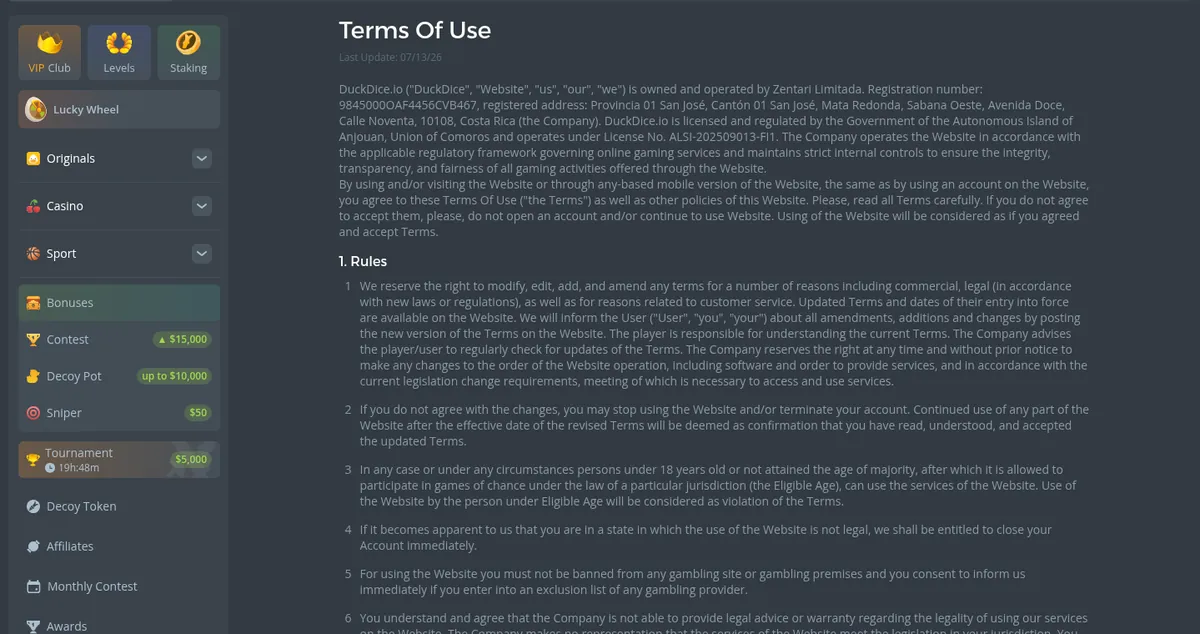
Section 2 frames verification as a judgement call: documents may be requested, with no amount named. The permit ALSI-202509013-FI1 appears in the public Anjouan register under Zentari Limitada, and the coin list runs to ten entries.
Two of the caps mean something other than they look like
Rocketpot’s clause 11.5 stops short of a general monthly cap. The sentence is conditional: it deals with winnings of 5,000 dollars or more, and it is for such winnings that the operator reserves the right to pay out at most 5,000 dollars a month. A win below that level falls outside the clause entirely.
Wild.io has two caps rather than one. The terms state 100,000 dollars over a seven-day period and 200,000 dollars over a thirty-day period. We entered the seven-day figure in the table because it is the one that bites first, and set out the other here.
Wild Fortune’s monthly cap is moreover stated in six currencies at once — euros, US, Canadian, Australian and New Zealand dollars and Norwegian kroner — and the operator writes that larger balances may be split into monthly instalments. A maximum per payment method is missing, with only the note that it varies with the method.
What a cap means in practice
A cap governs how fast the money arrives rather than whether it arrives. A win above the cap is split and paid over several periods, unless the terms say otherwise.
That makes the combination of cap and verification threshold the interesting quantity. A low monthly cap alongside an open-ended verification clause means that both the amount and the timing sit outside your control. An operator can have a high verification threshold and a low monthly cap, in which case the cap is what determines how quickly the money arrives.
What an empty cell means in our table
Six operators mention a cap nowhere in what we read. The tenth row, the advertising partner Vave, sits outside the count made on 26 August 2026: its terms were read later, and a withdrawal cap is missing from the text we read. We leave a cell unfilled rather than take it from other comparison sites.
An empty cell therefore means the information eluded us. It means something other than zero, something other than an absent check and something other than an open limit. A cap left unwritten may exist anyway and be applied when it becomes relevant; writing the absence up as unlimited withdrawals would turn the operator’s silence into a benefit. The routine is on the page about how we read the documents.
It is also why this page stops short of claiming that any of the operators is anonymous. None of the wordings we read rules out documents being requested.
Five out of a hundred spell out an amount
The three amounts above look like a third of the table. Set against the whole sample they are something quite different.
The collection holds 100 operators. Five of them state an amount at which documents are requested: Empire.io 2,000 USDT, Bitcasino.io 2,500 EUR, Rocketpot 2,500 USD, Sportsbet.io 2,500 EUR and Livecasino.io 2,500 EUR. Three of the five are in the table on this page; the other two sit outside it.
A further 21 cite a clause number without writing any figure, which makes 26 of 100 with a readable reference at all. The remaining 74 describe a judgement call lacking both amount and clause.
Three of the five amounts are moreover the same figure in the same currency under the same clause number: Bitcasino.io, Sportsbet.io and Livecasino.io all write 2,500 EUR in clause 6.6. Three brands with identical wording in an identical place in a document say something about how the terms text came about, and nothing about how the amount was chosen. We note the coincidence and draw zero conclusions about who is behind whom; how we handle such similarities is on the page about how we read the documents.
The conclusion from the count is simple. A published threshold falls outside the norm in this part of the market — it is the exception, and that is why it carries double weight in our measure.
One of the two longest coin lists in the table: thirteen coins, with usdt and usdc among the six given prominence. We read the permit number ALSI-132405048-FI3 here, on the operator’s own page rather than in the Anjouan register; the company behind the brand is Cipher Games Ltd.
What the documents consist of, and the only deadline
The terms say when the check happens and sometimes also what is requested, and there Rainbet is the most detailed of the ten. Its list covers photographic identification, confirmation of address, a selfie and a verification call. A call is a different thing from an uploaded file, and it is the only one of the ten texts that mentions that form.
Rocketpot is the only operator in the table that spells out how long you have: requested documents on identity and source of funds must be supplied within 30 calendar days. None of the other nine sets of terms contains any deadline at all, either for your submission or for the operator’s handling.
Where in the sequence the check can fall also differs, and three of the wordings sit earlier than one would expect:
- Rocketpot may request documents before a deposit is credited, that is, before play rather than only before the withdrawal.
- Bitcasino.io writes that the check may take place at any time, including at the first deposit.
- Wild.io writes that the account may be subject to security checks before the first withdrawal.
- Wolf.bet may restrict the service until identity has been sufficiently established.
- Empire.io writes that the account may be suspended or closed if incorrect or misleading information has been given.
Read the five together and the picture differs from what the word threshold suggests. The check is tied to the operator’s assessment of the account rather than to a step in the sequence, and the three published amounts mark where an additional check is expressly to be expected rather than where the first one may come.
Rainbet’s two documents say different things
The same operator gives two answers to the question of when identity is verified, and they sit in two different documents.
The terms describe a possibility: identity may be required before the service is used or before winnings are withdrawn, and the operator reserves the right to check at any time. The anti-money-laundering policy instead describes a procedure: identity verification is applied at account creation and at certain transactions.
The first is a discretion, the second a step in the sequence. The table carries the discretionary wording, because it comes from the terms and the terms are what you accept; the other formulation is set out here. The contradiction sits in the source rather than in our reading.
Processing time is another matter
Four of the ten sets of terms give a processing time, and all four carry a clause number. Rocketpot writes in clause 11.3 that all requests are processed within 72 hours. Wild Fortune writes the same 72 hours in clause 11.6, but counted from approval rather than from the request, and three business days for bank transfers in clause 11.10. The advertising partner, Vave, gives itself up to three days in clause 8.1. Bitcasino.io writes up to three working days in clause 6.1 — but for fiat withdrawals only; for crypto no time is stated anywhere in the terms or the help centre, and empty means unread.
Six rows leave the question unanswered, and two of them contradict themselves. Wolf.bet writes in clause 15 § 1 that a withdrawal can take “a few days” without setting a figure, while the operator’s own FAQ speaks of up to 24 hours where a manual check applies; both texts are the operator’s. Rainbet writes 5 to 15 minutes on its homepage and nothing at all in section 8 of its terms, and homepage copy is not a term of the contract. Section 12 at Metaspins sets no time whatsoever.
The column is still missing from the table, but for a different reason than the field being empty everywhere: four rows in ten fill it and six do not, and a column left blank on more than half its rows says less than the sentences it would displace.
We have timed a payout nowhere either. This site lacks an account with all of the operators and has deposited nothing, so any figure about time would be a guess. What can be counted, and where it stops, is on the page about the measure behind a top list.
How to find the clause yourself
The opposite question, the minimum deposit, is answered by none of the clauses below; why that item is missing from the material is explained on the page about minimum deposits.
Open the terms and search for KYC, verification and identity. The clause is almost always in the same part as the withdrawals, because that is where the check is triggered. Then search for withdrawal limit, maximum withdrawal and payout.
Read whether an amount is given or a discretion, and read three things in the withdrawal clause: the amount, the period and the currency. If any of the three is missing, the term is incomplete, and that in itself is worth noting.
None of the above follows from the Gambling Act. Verification requirements at an operator without a Swedish licence are contract terms, and the statute leaves the contract between you and a foreign counterparty ungoverned; what it does govern is on the page about what the statute says. Which company you have that contract with follows from the permit detail, which is dealt with on the page about offshore licences.