
From the operator’s own terms
Empire.io stands as valid with a date that has passed
The Anjouan register entry gives validity to 27 May 2026 and status valid at the same time, read 3 months later. Empire.io is also the only row whose terms we read in an archived copy rather than directly.
The contradiction in the register, which we leave uninterpreted
The register entry at Anjouan reads ALSI-132405042-FI3, issued on 28 May 2024 to Pixel Entertainment Limited, with validity to 27 May 2026.
That date had already passed when we read the entry on 26 August 2026, while the status in the same entry stood as valid. Two pieces of information on the same row therefore point different ways.
We set out both as they stood. Calling the permit expired would be choosing one line over the other, and calling it valid would be choosing the opposite; the contradiction sits in the source rather than in our reading. How we handle such cases is on the page about how we read the documents.
The permit is also the oldest of the nine dated ones in the table. The number carries its own dating: the digits 2405 in the middle of the series point to May 2024, which matches the entry.
The archived text behind the row
Empire.io is the only one of the ten whose terms we read as an archived copy rather than in a direct capture. That is a qualification worth writing out, since an archived text can lag behind the current one.
The qualification covers the whole row rather than a single item. The amount, the clause number and the country list below all come from the same copy, and they therefore reflect the document at the copy’s date.
Across the whole collection of a hundred operators, 37 texts were read directly, 41 in an archived copy and 22 yielded nothing readable at all. The difference between the three states is exactly the kind of detail that disappears in an ordinary comparison table.
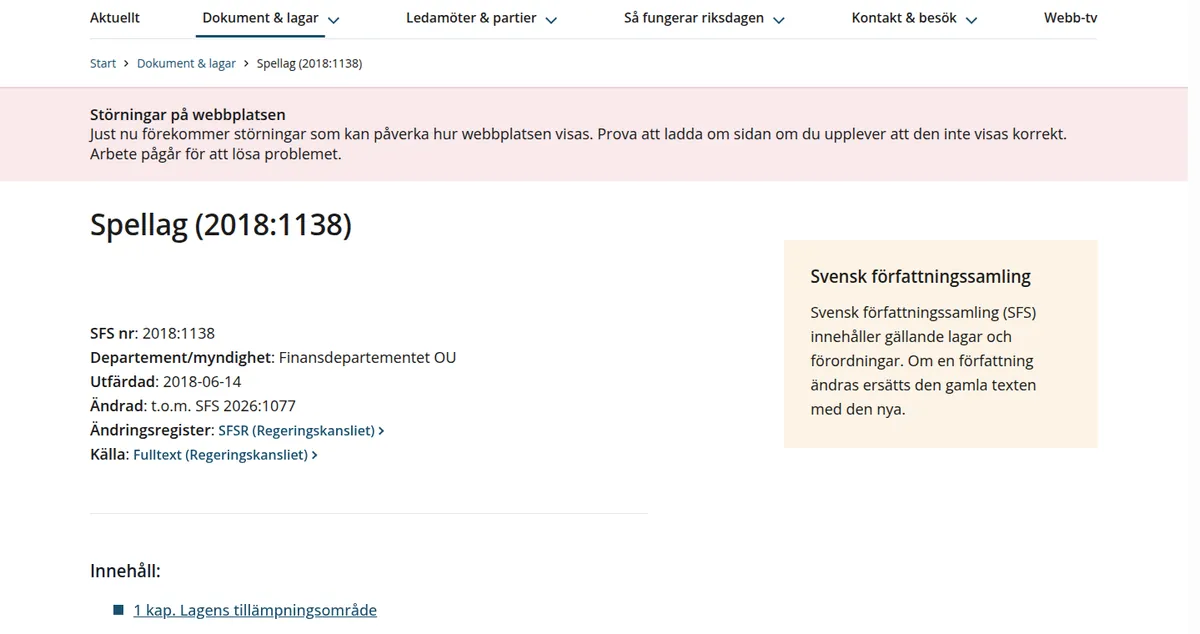
The text we worked from is the consolidated wording under SFS 2026:90, in force since 1 May 2026. This is where Chapter 19 on unlawful gambling operations sits, together with 14 kap. 12 § on self-exclusion and the two repealed sections in Chapter 18.
Clause 5.4: the lowest published amount
The verification threshold is 2,000 USDT and sits in clause 5.4. It is the lowest of the five amounts written down anywhere in the material, and one of three in this table.
The wording follows the same pattern as at Bitcasino.io: the operator reserves the right to carry out additional checks above the amount. The threshold therefore marks the point at which an extra check is expressly to be expected, rather than a level that keeps checks away.
The terms add a sanction as well. The account may be suspended or closed if incorrect or misleading information has been given. A deadline for submitting documents is missing from the text, however, and only one of the ten rows supplies one.
What the withdrawal terms leave out
A cap on withdrawals is missing from what we read, and the cell therefore stands empty in the table. Empty means unread, which is something other than zero and something other than an open limit.
That is worth holding together with the previous section. A published verification threshold alongside an unstated cap means the amount is known while the pace stays hidden. Four of the rows publish a cap, and what one actually settles is described on the page about identity checks and withdrawals.
A coin list eluded us too, unlike at seven of the ten rows. That cell stands empty too.
The country list with a single EEA country
The list of excluded countries covers twelve entries, and only one of them lies within the EEA: Estonia. Sweden is absent from it.
Set against the licence’s own conditions the list is the most divergent in the table. Anjouan’s standard conditions name Austria, Germany, France, Spain and the Netherlands as prohibited jurisdictions on the ground of state monopolies, and Empire.io’s own list names none of the five.
We leave the reason open. The lists are written for different purposes and may well differ in content, but the difference is practical for a customer in one of the five countries, since a dispute is brought under the licence whose conditions the issuer drafted. The whole comparison is on the page about offshore licences.
The issuer’s name shifts between documents
The anti-money-laundering policy names the Anjouan Gaming Control Board as designated supervisory authority, while the licence pages say the Government of Anjouan.
That is nothing peculiar to this row. Across the hundred operators the issuer is written in eight different ways, and three of the ten in the table use different names on different pages of their own site. A name therefore falls short of an identifier in this material; the number is, and the register decides.
The supplier list covers 79 names and also comes from a saved copy, with the earliest hit dated 7 February 2023.
What the row leaves unsettled
The permit, the amount in clause 5.4 and the country list all leave Swedish law untouched. The exemption under 8 kap. 3 § of the Income Tax Act turns on where the gambling is provided and on whether a Swedish permit is required, rather than on where the licence was issued; both limbs are dealt with on the page about tax on winnings.
We lack an account with the operator and have deposited nothing. The details above were read on 26 August 2026, with the qualification about the archived text standing until the documents can be captured directly.
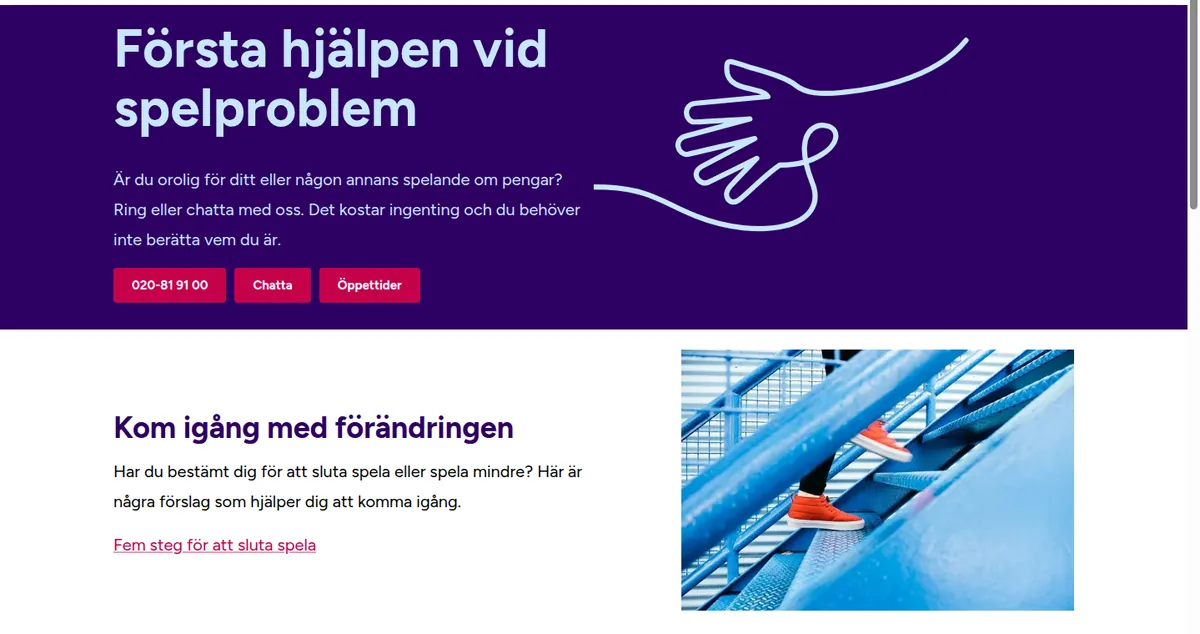
Free support on 020-81 91 00, with no ID required. Stödlinjen is run by Stockholms läns sjukvårdsområde with funding from the Public Health Agency of Sweden, which makes it a public service rather than an industry one.