
From the operator’s own terms
Wild.io has two withdrawal caps, and the table shows only one
Clause 9.6 gives 100,000 USD over 7 days and 200,000 USD over 30 days. The operator also holds 2 permits in 2 registers, issued seven days apart and to two different company names.
Two caps in one and the same clause
Clause 9.6 contains two caps rather than one: 100,000 dollars over a seven-day period and 200,000 dollars over a thirty-day period.
The table carries the seven-day figure, because it is the one that bites first. We set the other out here rather than discarding it, and the reason is that the two are far from interchangeable: four weeks of the first cap comes to four hundred thousand dollars, while the second stops at half that.
A cap governs how fast the money can arrive rather than whether it arrives at all. The combination of a cap and an open-ended verification clause means that both the amount and the timing sit outside the customer’s control, which is the same as for the three other caps on the page about identity checks and withdrawals.
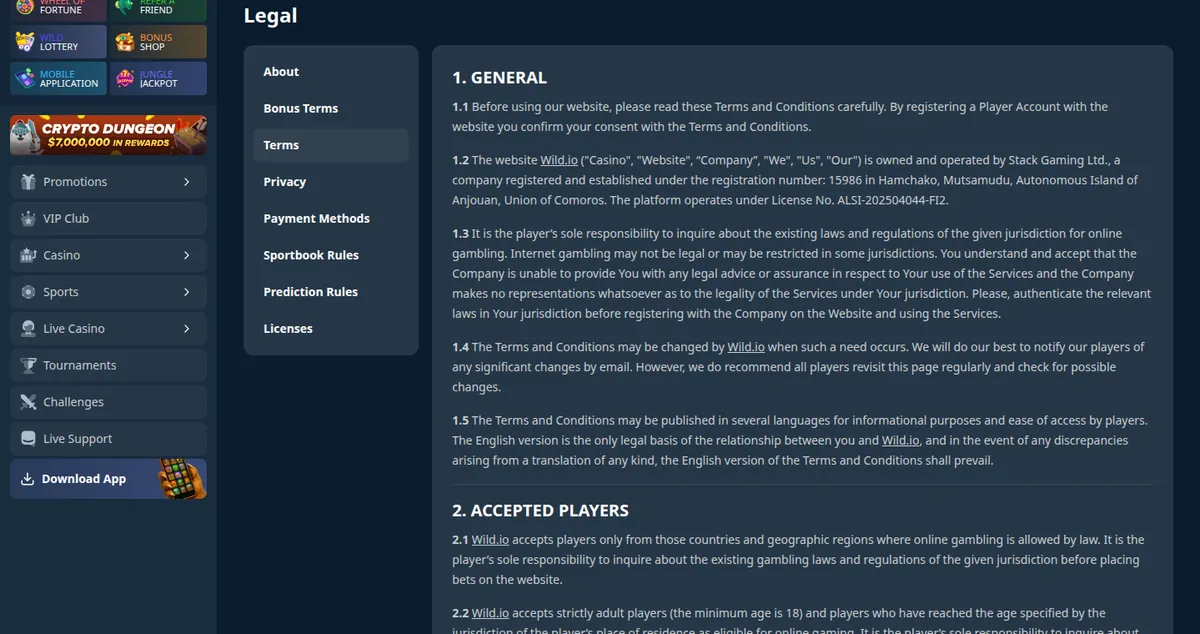
This is where the withdrawal cap of 100,000 USD per week in clause 9.6 comes from. We found the permit number OGL/2024/210/0198 in the Curaçao certificate register, and the company on the permit is Nonce Gaming B.V.
Two permits, issued seven days apart
The Curaçao certificate register answers with OGL/2024/210/0198, granted 14 April 2025, company Nonce Gaming B.V., status Active. The Anjouan register answers with ALSI-202504044-FI2, issued 21 April 2025 and valid to 20 April 2027, company Stack Gaming Ltd.
Seven days separate the two issues. The operator’s own site carries the Anjouan number, while the Curaçao certificate reads the other — which means somebody who tries the footer number in the wrong register gets nothing back and has thereby shown nothing.
What deserves attention is the names rather than the number of permits. The counterparty to a contract is the company named in the terms, and two registers answer here with two different names. Metaspins has the same double set, and both cases are set out on the page about new casinos.
The year in the Curaçao number is moreover something other than a year of issue: the number reads 2024 and the certificate was granted in April 2025.
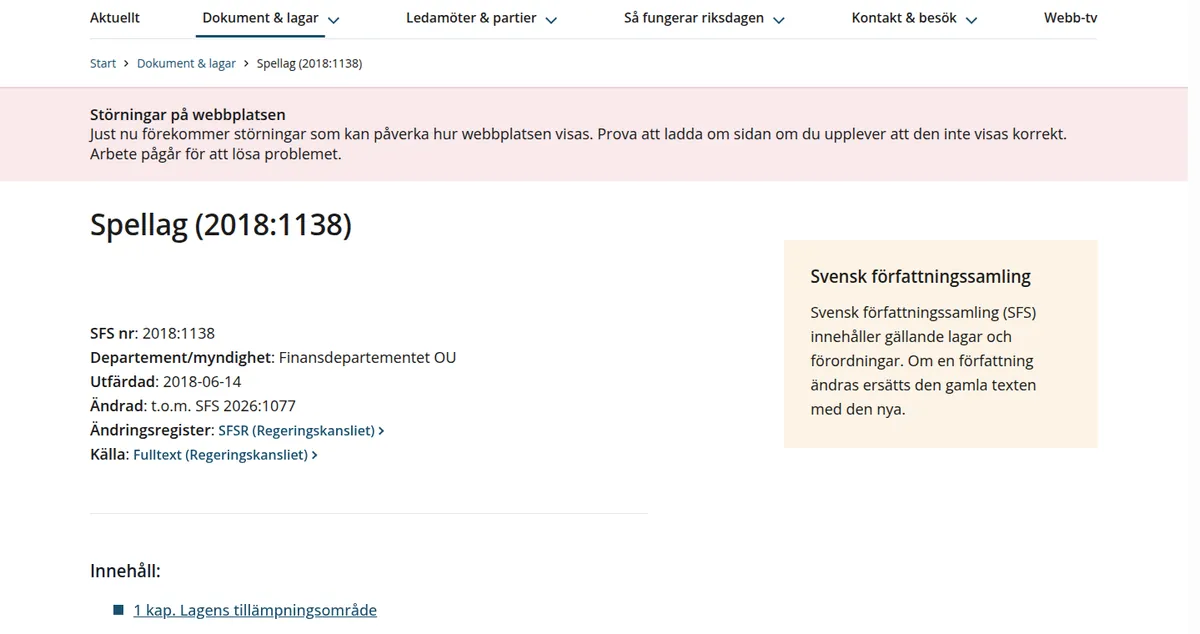
The text we worked from is the consolidated wording under SFS 2026:90, in force since 1 May 2026. This is where Chapter 19 on unlawful gambling operations sits, together with 14 kap. 12 § on self-exclusion and the two repealed sections in Chapter 18.
Verification: a wording without a clause number
The terms describe the check as a judgement call, but unlike the other discretionary rows we failed to find a clause to cite. The wording exists; the number that would make it possible to look up is missing.
That is a smaller gap than a missing amount, but it is of the same kind. A clause number is what makes a term checkable by somebody other than whoever read the text, which is why the reference counts as a check of its own in our measure — what the measure weighs is on the page about the measure behind a top list.
The terms also put the check earlier than the word threshold suggests: the account may be subject to security checks before the first withdrawal. An amount is missing from that wording.
What the operator publishes about its range
The coin list covers twelve entries, and the supplier list 80 names — the second longest of the six we could read.
The founding year 2022 comes from the operator’s own page and is one of two such years in the table. A year in a footer cannot be looked up with anyone else, and it may in any case refer to the brand, the company or the current website without the text saying which.
For this row we also noted a route into fiat through the exchange service Changelly. That is the kind of detail that makes a simple label like crypto-only insufficient, and it is why we leave the row unlabelled.
The country list
The list of excluded countries covers 45 entries, and Sweden is absent from it. The list is the operator’s own statement about itself at a particular moment, read on 26 August 2026.
The Netherlands, Spain and France are among the countries recurring on the most of the 38 country lists we read across the whole material. A country excluded by two thirds of the operators is hardly excluded for reasons specific to that one operator, and what can be read out of the pattern is on the page about offshore operators.
What the row leaves unsettled
Two foreign permits fall short of replacing one Swedish one. The exemption under 8 kap. 3 § of the Income Tax Act turns on where the gambling is provided and on whether a Swedish permit is required, and therefore on something other than where the certificate was issued; both limbs are dealt with on the page about tax on winnings.
We lack an account with the operator and have deposited nothing. The terms and both register entries were read on 26 August 2026.