
From the banks' terms and from the operators' own
What closes Swish off is a clause in the bank’s terms
Under the banks' terms, Swish Handel receives payments in Swedish kronor. None of the 10 operators in the table publishes a single amount in kronor: the three identity-check thresholds are stated in USD, EUR and USDT.
| Operator | Licence | Coins | Before ID check | Open |
|---|---|---|---|---|
| Rocketpot | Curacao | 13 | US$2,500 | Go to the casino siteRead |
| Bitcasino.io | Curaçao Gaming Authority | 12 | 2,500 EUR | Go to the casino siteRead |
| Wild Fortune | Anjouan Gaming Board | 10 | case by case | Go to the casino siteRead |
| DuckDice | Anjouan Gaming Board | 10 | case by case | Go to the casino siteRead |
| Empire.io | Anjouan Gaming Board | not read | 2,000 USDT | Go to the casino siteRead |
| Metaspins | Curaçao Gaming Authority | 9+ | case by case | Go to the casino siteRead |
| Rainbet | Anjouan Gaming Board | 9+ | case by case | Go to the casino siteRead |
| Wild.io | Curaçao Gaming Authority | 12 | case by case | Go to the casino siteRead |
| Wolf.bet | Government of the Autonomous Island of Anjouan, Union of Comoros | 32 | case by case | Go to the casino siteRead |


What Swish Handel is, according to the terms that govern it
A business that accepts Swish does so through a contract with its bank rather than through Swish itself. Nordea’s general terms 9739V008, in the November 2024 wording, open by stating that the service is provided by the bank, and Swedbank’s terms Bl 2252 describe the same thing: the customer gets a Swish number linked to an account at the bank, and the payment goes directly between the payer’s and the recipient’s accounts.
Swedbank’s clause 3 sets the frame:
Swish Handel is intended for traders carrying on e-commerce, via web or mobile device, and/or physical retail, in order to receive payments on their own behalf in Swedish kronor in real time from private individuals connected to the Swish Privat service.
Two things follow straight from that sentence. The recipient has to be a trader with a bank contract and an account at the Swedish bank, and the amount has to be in kronor. The trade mark is owned, under Nordea’s clause 9, by Getswish AB.
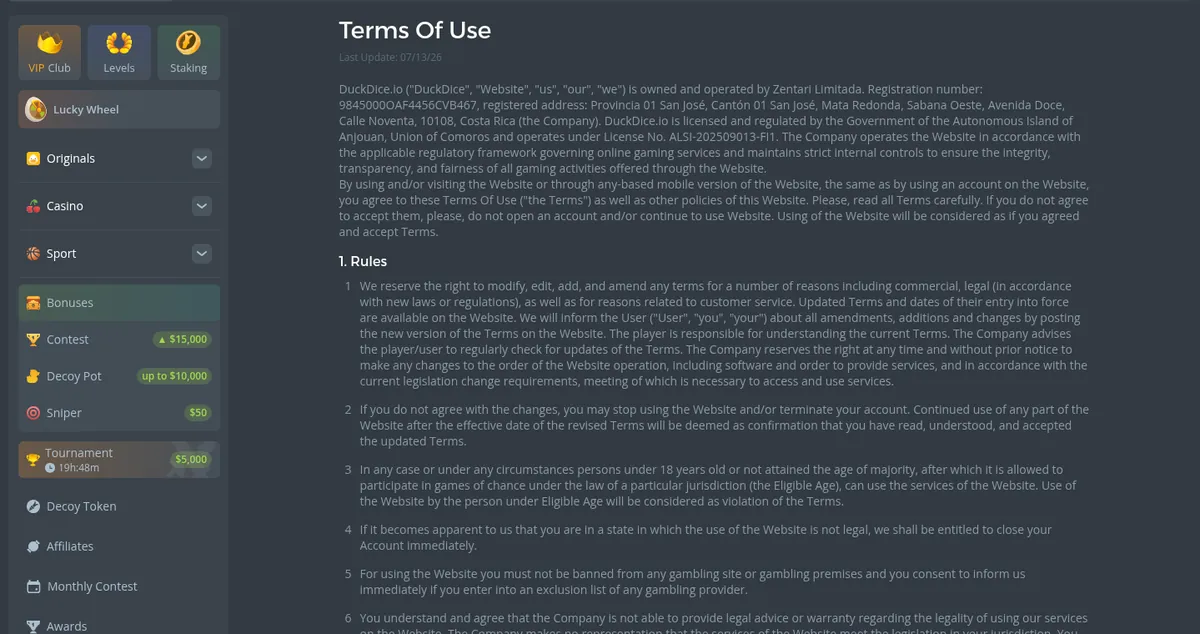
Section 2 frames verification as a judgement call: documents may be requested, with no amount named. The permit ALSI-202509013-FI1 appears in the public Anjouan register under Zentari Limitada, and the coin list runs to ten entries.
The clause that mentions gambling, word for word
Nordea’s terms have a clause of their own about what the customer may deal in. Clause 8 opens like this:
The service may not be used in connection with activities that the Bank considers unethical or immoral, or that in the Bank’s assessment may entail a financial risk for the Bank.
There follows a list of goods and services the customer may not supply, ending with an indent that points straight at this subject:
gambling, lotteries, gaming or the like where the necessary permits for it are lacking in Sweden.
The list moreover begins with goods and services that may not be sold under a statute, ordinance, court decision or authority regulation, and with those lacking an approval prescribed by an authority. Swedbank’s corresponding clause 8 is drafted differently but lands in the same place: the service may not be used in a business carried on contrary to Swedish law or without a permit where one is required.
This is therefore something other than an official decision or a technical block. It is a contractual clause between a bank and its business customer, written by the bank, and it bites before any authority has to do anything at all.
Why the card-code rule answers a different question
The rule usually called the payment block is 13 kap. 1 § of spelförordningen (2018:1475), the Gambling Ordinance, and it reads:
Payment service providers under the Payment Services Act (2010:751) shall refuse payment orders where a payment card is used and authorisation takes place through the use of the merchant category code (MCC) 7995.
Read the words where a payment card is used. The rule is drafted about card purchases and about the authorisation that takes place in the card network. A Swish payment falls outside card payments: it is initiated in the payer’s own app and moves as a real-time account transfer. The card-code rule therefore falls short of it, and anyone writing that Swish has been blocked since 2023 is citing the wrong provision.
The whole sequence — the two sections repealed in 2023, the ordinance that entered into force the same day, and the two provisions drafted without a card — is on the page about what the statute says.
What sits behind the bank’s caution
19 kap. 2 § of spellagen penalises anyone who intentionally or through gross negligence promotes participation in gambling without the required licence, with a fine or imprisonment for at most two years. The provision names zero occupations, but it describes an act that a payment intermediary in the chain between player and operator could come close to.
To that is added 13 kap. 1 c § of the Gambling Ordinance, which obliges Spelinspektionen to keep payment service providers informed of injunctions and prohibitions against companies that provide gambling without the required licence or that provide payment solutions for the gambling industry. A bank that writes a clause 8 settles that question in advance rather than testing it afterwards.
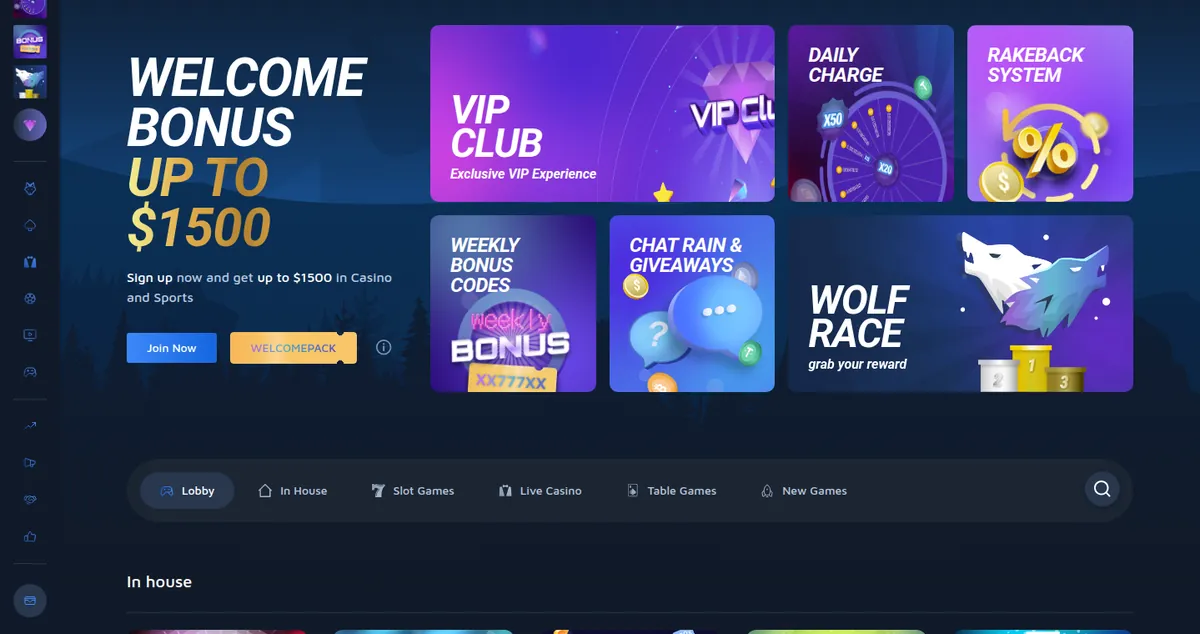
One of the two longest coin lists in the table: thirteen coins, with usdt and usdc among the six given prominence. We read the permit number ALSI-132405048-FI3 here, on the operator’s own page rather than in the Anjouan register; the company behind the brand is Cipher Games Ltd.
What the operators' own terms actually mention about payment
Our material lacks a field for payment methods, and none of the notes we took from the ten sets of terms mentions Swish. That means the document says nothing on the point, which is something other than the method being absent. The distinction is the whole basis on which this site is built.
Four operators do, however, write something about the payment route that can be quoted:
- DuckDice keeps a separate country list for card payments on fiat withdrawals, distinct from the blocking list that applies to the account in general. The terms therefore know about both cards and fiat, and treat them separately.
- Metaspins writes in clause 12.5 that the maximum withdrawal amount may be limited depending on which payment method is chosen. The methods go unlisted, though the clause presupposes that there are several.
- Wild Fortune leaves the maximum per method unstated and writes that it varies with the method. The monthly cap is listed in euros, US, Canadian, Australian and New Zealand dollars and Norwegian kroner. Swedish kronor is missing from the list.
- Bitcasino.io has a footer box labelled Payment methods, and the only thing we could read in it was the exchange rate 1 USDT = 1 USD. A list of accepted coins is missing there.
Three of the ten carry the tag crypto-only in our material: Rocketpot, Metaspins and Wolf.bet. That tag is our own summary of what the cashier and the terms showed, rather than a quotation from them — and it should be read carefully. For a fourth operator, Wild.io, we noted a route into fiat through the exchange service Changelly, which is exactly the kind of detail that makes such a label insufficient.
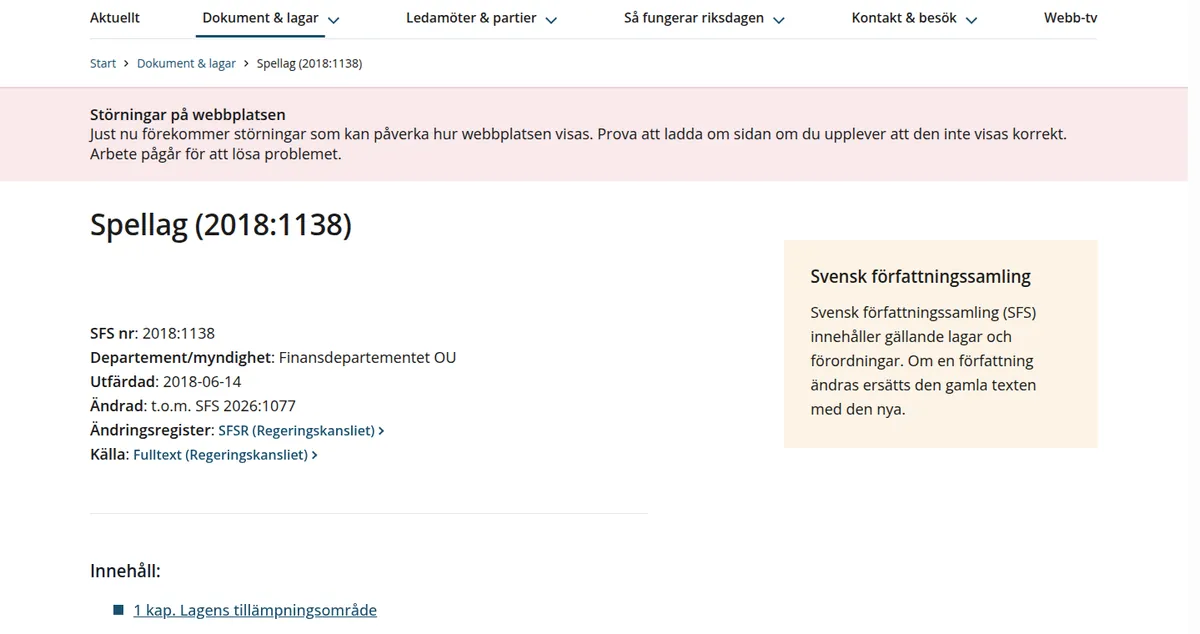
The text we worked from is the consolidated wording under SFS 2026:90, in force since 1 May 2026. This is where Chapter 19 on unlawful gambling operations sits, together with 14 kap. 12 § on self-exclusion and the two repealed sections in Chapter 18.
The currencies in the terms are anything but kronor
What can be documented with figures points the same way. Seven of ten publish a coin list, from eight coins at Metaspins to thirteen at Rocketpot and Wolf.bet. Every published threshold and cap is stated in USD, EUR or USDT, and zero of the four withdrawal caps are set in kronor.
A balance measured in something other than what you count in carries an extra moving part: the rate changes while the money sits there, and it applies to the deposit as much as to the win. The amounts, with period and clause number, are on the page about identity checks and withdrawals.
Fourteen of a hundred publish a cap, and none of them in kronor
The clause about kronor concerns the recipient. What can be checked on the other side of the transaction is which currency the operators themselves count in, and there the material stretches further than the ten rows.
The collection holds 100 operators. Fourteen of them publish a cap on withdrawals, stated in euros, dollars and USDT — plus one written in two currencies at once, EUR/USD. None of the fourteen states its cap in Swedish kronor.
The periods differ too: six caps are counted per week, five per month, two per day and one per individual transaction. The lowest published cap in the collection is 4,000 euros per day, stated by two operators; the highest is 1,000,000 USDT per week. The two cannot be compared directly, because the periods differ and none of the sets of terms contains an exchange rate to work with.
The conclusion is the same as in the table, but broader: the currency in the terms is rarely yours. A balance measured in something other than what you count in carries an extra moving part, and it applies to the deposit as much as to the win. The four caps among the ten in the table appear with amount, period and clause number on the page about identity checks and withdrawals.
The text we worked from is the consolidated wording under SFS 2026:90, in force since 1 May 2026. This is where Chapter 19 on unlawful gambling operations sits, together with 14 kap. 12 § on self-exclusion and the two repealed sections in Chapter 18.
What clause 8 leaves unsaid
The bank clause is easy to over-read in two directions, and both misreadings are worth spelling out.
It says nothing about the payer. The list sits in the terms for Swish Handel, that is, in the contract between the bank and its business customer, and it describes what that customer is barred from supplying through the service. Whoever pays stands outside that contract.
It is also something other than a decision by any authority. A contractual clause written by a bank can be changed by the same bank without any statutory provision being amended, and the two banks in our reading have drafted their clause differently: Nordea lists activities and ends with gambling lacking the necessary Swedish permits, while Swedbank writes generally about business carried on contrary to Swedish law or without a permit where one is required. The same outcome, two wordings, and we have read the terms of two banks out of several in the market.
What does sit in a statute is the card-code rule, and that deals with something other than this payment route. The relationship between the two, and the two sections drafted without a card, is on the page about what the statute says.
The question of ten euros
One of the commoner additions to this search term concerns the minimum deposit. That information is missing from our material. We have read licences, coin lists, verification clauses and withdrawal caps, and none of the four contains a minimum deposit amount.
An answer in euros or kronor would therefore come from somebody else’s summary, and we leave those unquoted, for reasons set out on the page about how we read the documents. What we can show is the other end of the scale: the ceiling rather than the floor. What can be said about small amounts — the verification thresholds, the hundred-krona limit in the tax rules and the currency — is gathered on the page about minimum deposits.
How to check the cashier yourself
Open the cashier page before you register. The list there is the one that applies, and it is updated more often than the marketing text on the front page.
Check that the method exists for both deposits and withdrawals. The two lists differ at times, and the difference shows up only when the money is going out — DuckDice’s separate country list for card withdrawals is one example of exactly that asymmetry.
Finally, check which company sits behind the cashier. The name is in the permit detail, and where we found it for each row is set out on the page about offshore licences. The question of the other Swedish payment route, account-initiated transfers, belongs on the page about Trustly.