
The EEA point, limb by limb
An EU permit proves something about the EU rather than about Sweden
The phrase EU casino carries an unstated claim about tax. That claim rests on 1 sentence in the Income Tax Act, the sentence has 2 limbs, and the second concerns something other than where the permit was issued.
What the phrase carries without saying it
When somebody searches for an EU casino, geography is rarely what is being asked about. The phrase has stuck because it is used as shorthand for two other things: that the operator is under supervision resembling the European kind, and that a win from it would be tax free in Sweden.
The first part is a description that can be checked in a register. The second is a legal claim, and that claim rests on a single sentence in the Income Tax Act. The sentence sits in 8 kap. 3 § and it has two limbs, both of which have to be satisfied.
This page takes the sentence apart and shows what each half actually asks for, because it is the second half that does the work and the second half that almost always drops out of the summaries.
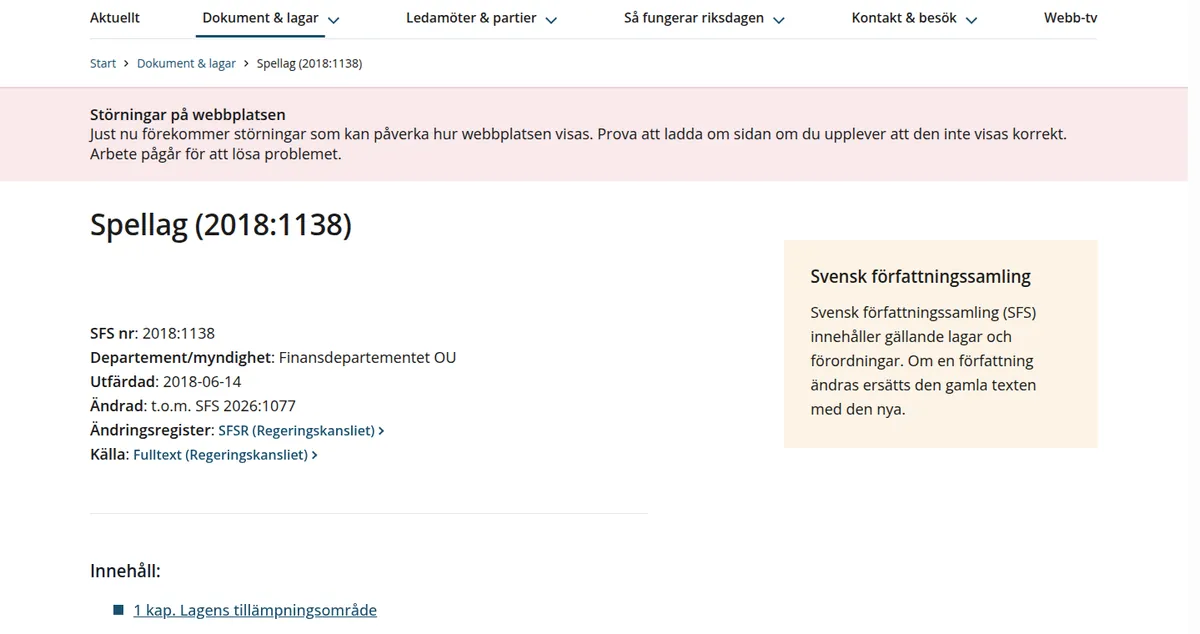
The text we worked from is the consolidated wording under SFS 2026:90, in force since 1 May 2026. This is where Chapter 19 on unlawful gambling operations sits, together with 14 kap. 12 § on self-exclusion and the two repealed sections in Chapter 18.
The EEA is thirty states rather than twenty-seven
The European Economic Area covers the member states of the EU plus Norway, Iceland and Liechtenstein. The tax provision speaks of the EEA rather than of the EU, and the difference is three states wide.
It is therefore something other than a judgement about quality or about a type of supervision. The provision identifies a geographical and legal area and asks for a state within that area. An authority that keeps a high standard while sitting outside the area is beside the point, and a state inside the area is beside the point on its own too — which is what the next section is about.
Malta belongs to the EU and therefore to the EEA. That is probably the commonest meaning of the phrase EU casino in Swedish searches, and it is also why the phrase confuses: a permit issued in an EEA state differs from gambling provided in an EEA state, and it is the latter that the provision asks about.
The second limb points back at the Gambling Act
The third ground in 8 kap. 3 § says the win is tax free if the gambling is provided in a state within the EEA and a Swedish licence is unnecessary for it. The words are joined by an “and”, which means both have to hold at the same time.
The second limb is answered in 1 kap. 2 § of spellagen rather than in the tax statute: the Act applies to gambling provided in Sweden, and online gambling aimed away from the Swedish market counts as provided elsewhere.
Read the two sentences backwards and it becomes a loop that is easy to miss. If the gambling is directed at Swedish customers it is regarded as provided in Sweden. If it is regarded as provided here, a Swedish licence is required. If a Swedish licence is required, the second limb of the tax provision fails. And then the exemption falls — whether the operator sits in Valletta, Tallinn or Willemstad.
That is why the shortcut that an EU licence means tax free fails even in its own best case. An operator inside the EEA that aims here without a Swedish permit satisfies the first limb and fails on the second.
Four items an answer in an individual case would require
The question can be answered, though hardly with the information a comparison site has. What would be needed is four things, and only the first appears in a register:
- Where the permit was issued and by whom.
- Where the business is actually carried on, that is, from where the gambling is provided.
- Whether the offering is directed at the Swedish market in the sense 1 kap. 2 § intends.
- Whether the gambling therefore requires a licence under the Gambling Act.
Points two to four are assessments rather than fields in a database. The last is made ultimately by Skatteverket and beyond that by a court, and it can land differently from a reading at the kitchen table. We therefore apply none of them to any individual operator, and we write of zero rows in the table that a win from them would be tax free or taxable.
What our own material says about the EEA
The collection holds 100 operators. Sixty-seven of them name a permit issuer: forty point to Curaçao, twenty-six to Anjouan and one to Mwali. None points to a state within the EEA.
It looks the same among the ten rows in the table. There are two issuers — Curaçao and Anjouan — and both lie outside the area. The numbers, the company names and where we found them are set out on the page about offshore licences.
That figure still falls short of an answer to the tax question, for the reason above: it describes where the permits were issued rather than where the gambling is offered. We report it for what it is, a statement about issuers, and draw zero tax conclusions from it.
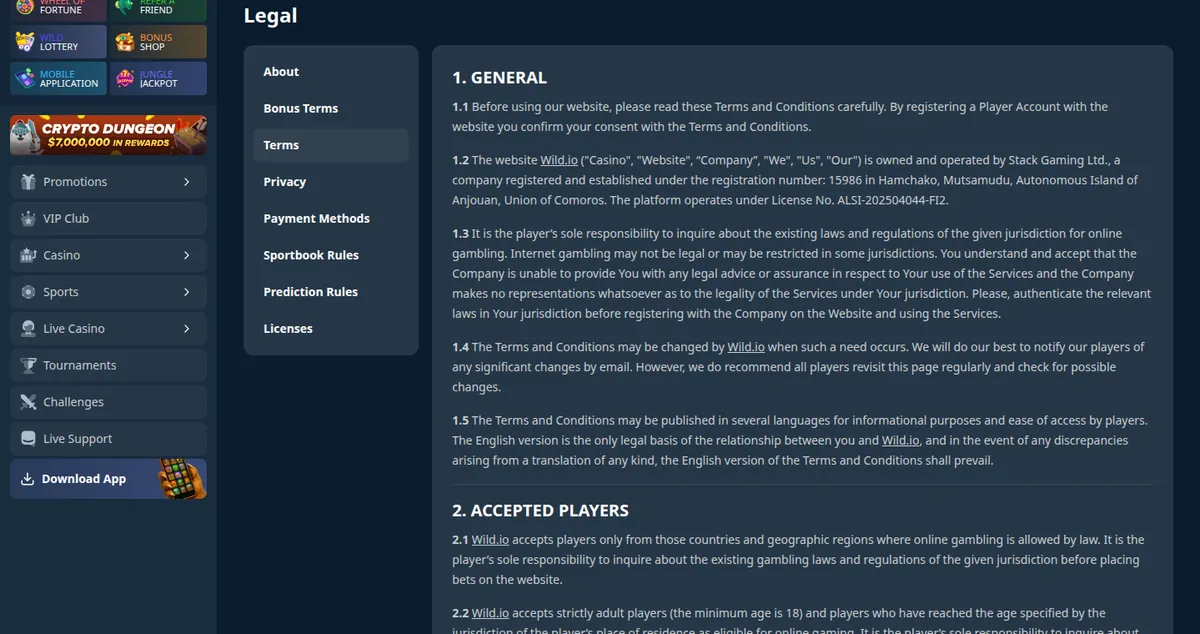
This is where the withdrawal cap of 100,000 USD per week in clause 9.6 comes from. We found the permit number OGL/2024/210/0198 in the Curaçao certificate register, and the company on the permit is Nonce Gaming B.V.
An EEA permit changes nothing in the Swedish protective rules
This is the other half of what the phrase EU casino tends to imply, and it is easier to settle than the tax question.
The exclusion under 14 kap. 12 § of spellagen applies at every licensee, that is, at operators holding a permit under the Swedish Act. A permit issued in Malta leaves its holder outside that circle, and the reach therefore stays exactly where it was. The section word for word and what it covers is on the page about how far Spelpaus reaches.
The same holds for the bonus rule in 14 kap. 9 §, the deposit limit in 14 kap. 7 §, the requirement of Swedish in 14 kap. 4 § and the gambling account with twelve months of history in 13 kap. 1–3 §§. Every one of them is drafted about the licensee under spellagen. The list with section numbers is on the page about online casinos.
Supervision follows the same boundary. Spelinspektionen’s injunctions under 18 kap. 23–25 §§ and the financial penalties under 19 kap. 10 § are aimed at whoever provides gambling in Sweden, with or without a permit; an authority in another EEA state supervises under its own rules rather than under spellagen.
Which European countries the operators exclude themselves
There is one piece of information in this area that does come from the operators in writing, and it points in an unexpected direction.
Of the 38 country lists we could read in full, 27 contain the Netherlands, 24 Spain, 23 France, 19 Lithuania and 16 Belgium. Sweden appears on eight of the lists. Anjouan’s standard conditions for its licensees moreover name five jurisdictions as prohibited on the ground of state monopolies: Austria, Germany, France, Spain and the Netherlands.
EEA membership therefore offers little protection against ending up on such a list — on the contrary, the most frequently excluded countries are EEA states. Which lists contain what, and how the Nordics fall out in the same material, is dealt with on the page about offshore operators.
How to check a claimed EEA permit yourself
The routine is the same as for any permit, and it takes a quarter of an hour.
Start in the issuer’s own register rather than in the footer. A number in a footer is a claim by the operator; a hit in the register is a statement by the authority. Compare three fields: the number, the company name and the issuer’s name.
Then read which company is named as counterparty in the terms. That is the name a dispute is brought against, and it differs at times from the name on the permit — two of the brands in our table hold permits in two registers under a different company name in each.
And finally read the country list in the terms. It says what the operator itself thinks about customers from your country, which is a different question from both the licence and the tax, and it is written by the operator and can be changed by the operator.
What this page refrains from claiming
It refrains from claiming that any of the operators in the table holds a permit within the EEA. None of the issuers we read sits there, and we leave unfilled the information we lack.
It equally avoids claiming that a permit within the EEA would make a win tax free. The provision asks where the gambling is provided rather than where the permit was issued, and the second limb has to be satisfied at the same time.
And it stops short of tax advice. The sections word for word, Skatteverket’s own account and the addresses to read them at are on the page about tax on winnings. Anyone unsure about their own case asks Skatteverket before filing the return rather than after.