
From the Gambling Act and the Gambling Ordinance
Online gambling is a defined term, nätcasino is not
The Swedish word nätcasino appears 0 times in the Gambling Act. The word onlinespel appears 12 times and is defined in 2 kap. 1 §, and it is that definition which draws the line between a licensed operator and an unlicensed one.
| Operator | Licence | Coins | Before ID check | Open |
|---|---|---|---|---|
| Rocketpot | Curacao | 13 | US$2,500 | Go to the casino siteRead |
| Bitcasino.io | Curaçao Gaming Authority | 12 | 2,500 EUR | Go to the casino siteRead |
| Wild Fortune | Anjouan Gaming Board | 10 | case by case | Go to the casino siteRead |
| DuckDice | Anjouan Gaming Board | 10 | case by case | Go to the casino siteRead |
| Empire.io | Anjouan Gaming Board | not read | 2,000 USDT | Go to the casino siteRead |
| Metaspins | Curaçao Gaming Authority | 9+ | case by case | Go to the casino siteRead |
| Rainbet | Anjouan Gaming Board | 9+ | case by case | Go to the casino siteRead |
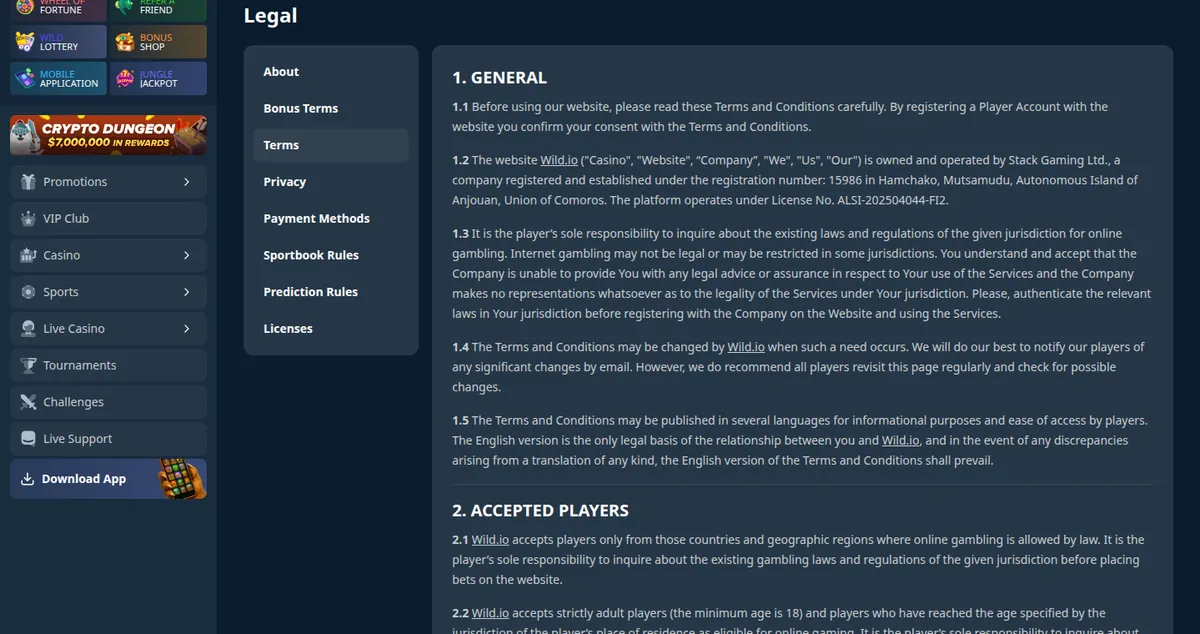
| Wild.io | Curaçao Gaming Authority | 12 | case by case | Go to the casino siteRead |
| Wolf.bet | Government of the Autonomous Island of Anjouan, Union of Comoros | 32 | case by case | Go to the casino siteRead |


The word is not in the statutes
We searched spellagen (2018:1138), the Gambling Act, and spelförordningen (2018:1475), the Gambling Ordinance, in their current wording. Neither contains the word nätcasino, the everyday Swedish term for an online casino. It is a marketing word rather than a legal concept, which means the question of what applies to such an operator has to be reframed before it can be answered.
The statute divides gambling up in another way. 2 kap. 1 § says:
1 § In this Act, gambling means lotteries, betting, combination games and pyramid schemes. Online gambling means gambling provided through the use of electronic means of communication and played between one player and the provider of the game, or between several players.
What everyday speech calls slots is a lottery in the meaning of the statute, because the chance of winning depends on randomness. Roulette, dice games and card games are gathered in 2 kap. 3 § under the term casino games. The permission to offer this online sits in 7 kap. 1 §, which grants a licence for commercial online gambling covering casino games, online bingo and computer-simulated slot machines.
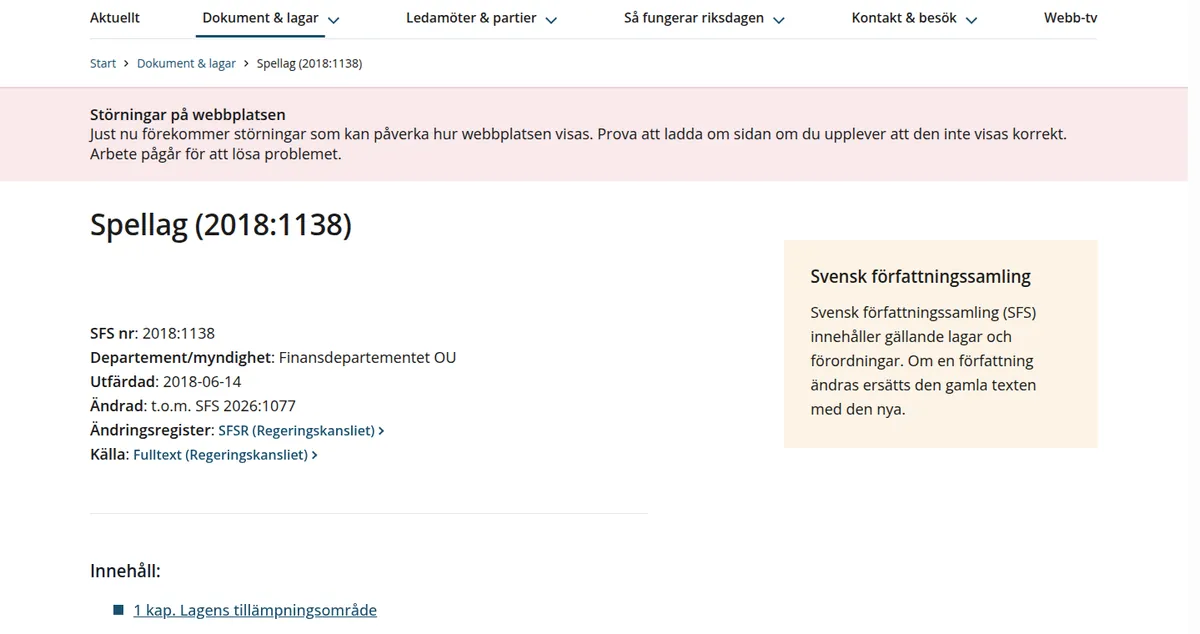
The text we worked from is the consolidated wording under SFS 2026:90, in force since 1 May 2026. This is where Chapter 19 on unlawful gambling operations sits, together with 14 kap. 12 § on self-exclusion and the two repealed sections in Chapter 18.
The authority is called one thing in the statute and another in life
Throughout, spellagen speaks of “the gambling authority”. That is a generic name rather than a proper one: the statute identifies a function and leaves it to the government to say who fills it. The function is filled by Spelinspektionen, the Swedish Gambling Authority.
The distinction is worth knowing when searching the statutory text. Search for the authority’s actual name and you find nothing; search for spelmyndigheten and you find every provision on supervision, registers and injunctions.
Seven duties that come with the permission
The difference between a licensed and an unlicensed operator can be described without value judgements, by listing what the Act imposes on a licensee.
Registration before play. 12 kap. 1 § requires the licensee to register anyone wishing to take part, and adds that only natural persons resident or habitually present in Sweden may be registered for online gambling.
Identity established before the first stake. Under 12 kap. 2 § identity must be verified in a satisfactory manner through a reliable electronic identification, and under section 4 play may not take place until identity has been established. The check therefore sits before the first stake, not before the first withdrawal.
A gambling account with history. 13 kap. 1 § requires a gambling account for every registered player, section 2 that the player be identified at every log-in, and section 3 that all transactions be recorded and kept available to the player for at least twelve months.
A deposit limit set by the player. 14 kap. 7 § says that in online gambling the player shall set an upper limit on their deposits. 11 kap. 3 § of the Gambling Ordinance specifies that the limit is set per day, week and month, that a reduction takes effect immediately and that an increase takes effect no sooner than 72 hours later. If the player raises the limit above 10,000 kronor a month, the licensee must contact the player under 11 kap. 5 §.
An age limit. 14 kap. 2 § sets it at 18.
Information in Swedish. 14 kap. 4 § requires all relevant information about the game to be available in Swedish.
Connection to the exclusion register. 14 kap. 12 § says an exclusion shall apply at every licensee, which makes the register a duty flowing from the permission. What that means in the other direction is on the page about how far Spelpaus reaches.
This is where the withdrawal cap of 100,000 USD per week in clause 9.6 comes from. We found the permit number OGL/2024/210/0198 in the Curaçao certificate register, and the company on the permit is Nonce Gaming B.V.
The bonus rule is the most keenly felt of the seven
The eighth duty is the one that sets Swedish licensing apart from most others in Europe, and it fits in a single sentence. 14 kap. 9 §:
A licensee may offer or grant a bonus only on the first occasion on which a player plays any of the licensee’s games.
One bonus, once, per licensee. The rule is drafted about the licensee and therefore binds only that circle. It is also the commonest explanation for why the phrase this site deals with is searched forty thousand times a month: what is being looked for sits outside the circle the provision is written about, and together with the exclusion register both protections fall away at once.
We have not measured how many people move away for that reason, and we claim nothing about individual motives. What can be documented is that both provisions contain the word licensee, and that both therefore stop at the same boundary.
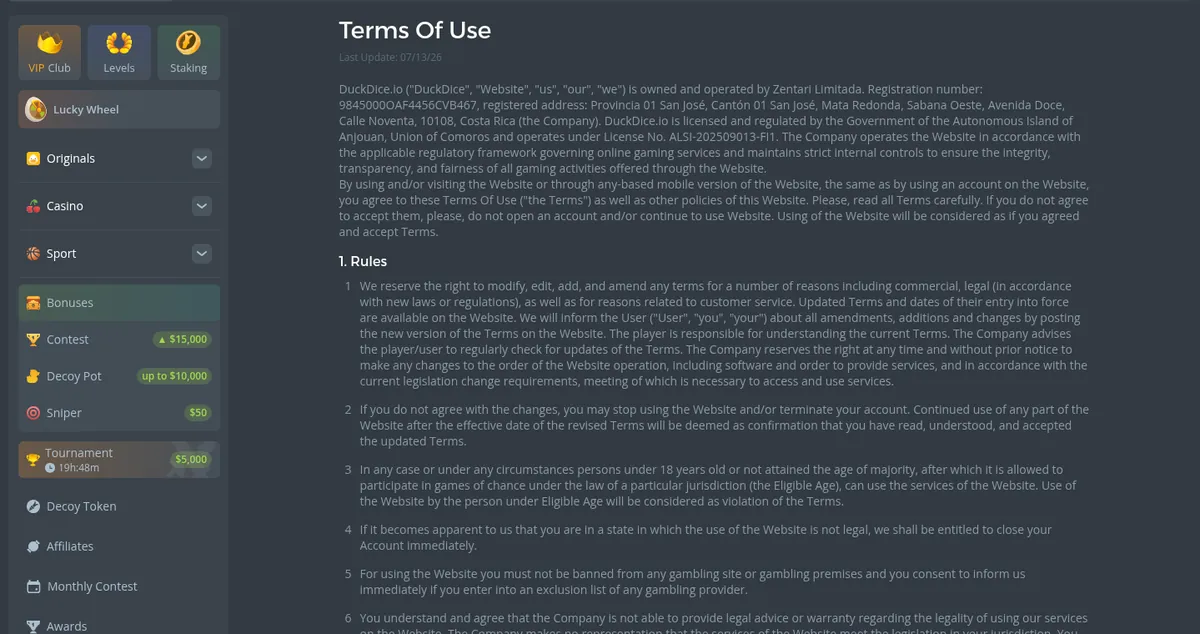
Section 2 frames verification as a judgement call: documents may be requested, with no amount named. The permit ALSI-202509013-FI1 appears in the public Anjouan register under Zentari Limitada, and the coin list runs to ten entries.
What the ten operators in the table publish instead
None of the duties above applies to an unlicensed operator, because every section is drafted about the licensee. What stands in their place is contract terms, and they look different.
Where the statute puts the identity check before the first stake, the terms put it at an amount or at the operator’s own discretion. Three operators state an amount with a clause number, six write that documents may be requested whenever the operator considers it necessary, and the difference is dealt with on the page about identity checks and withdrawals.
Where the statute requires the player to set a ceiling on deposits, four of the operators instead publish a cap on withdrawals, set by the operator, in three different currencies and across two different periods.
Where the statute requires information in Swedish, no such duty exists at all. We have not mapped which languages the terms are actually written in and therefore claim nothing about it. What we can note is which currencies they count in: Wild Fortune’s monthly cap is listed in euros, US, Canadian, Australian and New Zealand dollars and Norwegian kroner, and Swedish kronor is not among them.
Section 2 frames verification as a judgement call: documents may be requested, with no amount named. The permit ALSI-202509013-FI1 appears in the public Anjouan register under Zentari Limitada, and the coin list runs to ten entries.
The gambling account is the duty that shows least and matters most
Of the seven, the gambling-account requirement is the one rarely mentioned in summaries of the subject, and it is at the same time the one that gives the player most to work with.
13 kap. 1 § requires a gambling account for every registered player. Section 2 requires the player to be identified at every log-in. And section 3 requires all transactions to be recorded and kept available to the player for at least twelve months.
Twelve months is no arbitrary figure in this context. The tax year is twelve months, and the computation in 42 kap. 25 § of the Income Tax Act is made as the difference between total winnings and total stakes during the tax year with the same gambling provider. The history requirement therefore covers exactly the period the tax computation runs over, which is set out more fully on the page about tax on winnings.
None of the ten sets of terms we read mentions transaction history. We do not write that the operators keep none — the document says nothing on the point, and that is never the same as a no. We write that the duty does not exist, and that what exists instead is whatever each operator chooses to build.
The deposit limit and the withdrawal cap point in opposite directions
The two instruments resemble each other on the surface and are opposites in substance.
The deposit limit sits in 14 kap. 7 § and is specified in 11 kap. 3 § of the Gambling Ordinance: the limit is set per day, week and month, a reduction takes effect immediately and an increase no sooner than 72 hours later. If the player raises the limit above 10,000 kronor a month, the licensee must contact the player under 11 kap. 5 §.
Read who does what. The player sets the figure, the operator implements it, and the 72 hours are built so that an increase cannot be effected the moment it is wanted. The tool is aimed at what goes in, and the delay sits on the loosening rather than on the tightening.
The withdrawal cap in the ten sets of terms is the reverse. Four operators publish a cap, all four set by the operator, all four aimed at what comes out, and none of the four texts contains any delay on an increase, because it is not the player who changes it. Across the whole sample of 100 operators, 14 publish such a cap; the amounts, periods and clause numbers are on the page about identity checks and withdrawals.
None of the ten sets of terms mentions a player-set deposit limit. That too we record as a silence in the document rather than as an answer.
What happens to an unlicensed operator
Here are three instruments, and all three are aimed at the business.
- Injunctions or prohibitions under 18 kap. 23–25 §§, which may carry a conditional fine.
- Financial penalties under 19 kap. 10 § and the sections following it.
- Undercover test purchases, which the authority has been allowed to make since 1 July 2023, that is, buying anonymously from an operator in order to see how it behaves towards a customer.
What is missing from the list is at least as interesting. No provision lets the authority remove a domain or block traffic. The addressees of the penal provisions, the warning message in 18 kap. 28 § and the merchant-code rule that replaced the repealed payment block are gathered on the page about what the statute says.
What we have not checked
We have not gone through the authority’s permit register and counted the licensees, and we have not tested any individual operator against that register. This page therefore makes no claim that a particular operator is unlicensed in Sweden as the result of a search of our own.
What we have read is the permit detail for the ten operators in the table, in their own documents and in the issuer’s register where one exists. Nine of them name an issuer outside Sweden. Who those issuers are, and where the number could be confirmed, is on the page about offshore licences. What the word foreign settles in Swedish law is taken up on the page about offshore operators, and the commonest questions about the line between the two kinds of operator are answered on the page of questions and answers.