
From the statute and from the terms
Casino without a Swedish licence: one phrase, several questions
A casino unlicensed in Sweden is an operator that lacks a permit under spellagen, the Gambling Act. The penal chapter of that Act describes 2 basic offences, providing and promoting, and both leave the person placing the stake unmentioned.
The phrase says something about Swedish law and nothing about the operator otherwise. What the statute settles is set out below with section numbers, and what the operator’s own terms settle is set out with clause numbers, so that either can be looked up.
The table gathers ten such operators. Nine of the rows were counted on 26 August 2026, and all nine state a permit number from Curaçao or Anjouan; seven of the numbers could be found in the issuer’s own register. The tenth row is the operator advertising on this site, whose documents were read after that count and therefore sit outside every total on these pages — we looked up the permit OGL/2024/1676/0905, held by Latcas B.V., in the Curaçao certificate register on 2 September 2026.
| Operator | Licence | Coins | Before ID check | Open |
|---|---|---|---|---|
| Rocketpot | Curacao | 13 | US$2,500 | Go to the casino siteRead |
| Bitcasino.io | Curaçao Gaming Authority | 12 | 2,500 EUR | Go to the casino siteRead |
| Wild Fortune | Anjouan Gaming Board | 10 | case by case | Go to the casino siteRead |
| DuckDice | Anjouan Gaming Board | 10 | case by case | Go to the casino siteRead |
| Empire.io | Anjouan Gaming Board | not read | 2,000 USDT | Go to the casino siteRead |
| Metaspins | Curaçao Gaming Authority | 9+ | case by case | Go to the casino siteRead |
| Rainbet | Anjouan Gaming Board | 9+ | case by case | Go to the casino siteRead |
| Wild.io | Curaçao Gaming Authority | 12 | case by case | Go to the casino siteRead |
| Wolf.bet | Government of the Autonomous Island of Anjouan, Union of Comoros | 32 | case by case | Go to the casino siteRead |


What the phrase means in the statute
Under 1 kap. 2 § of spellagen (2018:1138), the Swedish Gambling Act, the Act applies to gambling provided in Sweden, and the same section adds that online gambling not directed at the Swedish market is not to be regarded as provided here. An operator lacking a permit that nevertheless aims at this market is therefore running a business the Act reaches.
The penalty sits in Chapter 19. Its first section calls the conduct unlawful gambling operations and sets a fine or up to two years' imprisonment. The second section penalises whoever promotes participation in such gambling, on the same scale, and that is the provision that reaches comparison sites and payment intermediaries.
Zero descriptions of an offence in the chapter are aimed at the person who stakes money. That is an observation about the text rather than advice, and it holds only as far as the words go. The whole chapter is reproduced on the page about what the statute says.
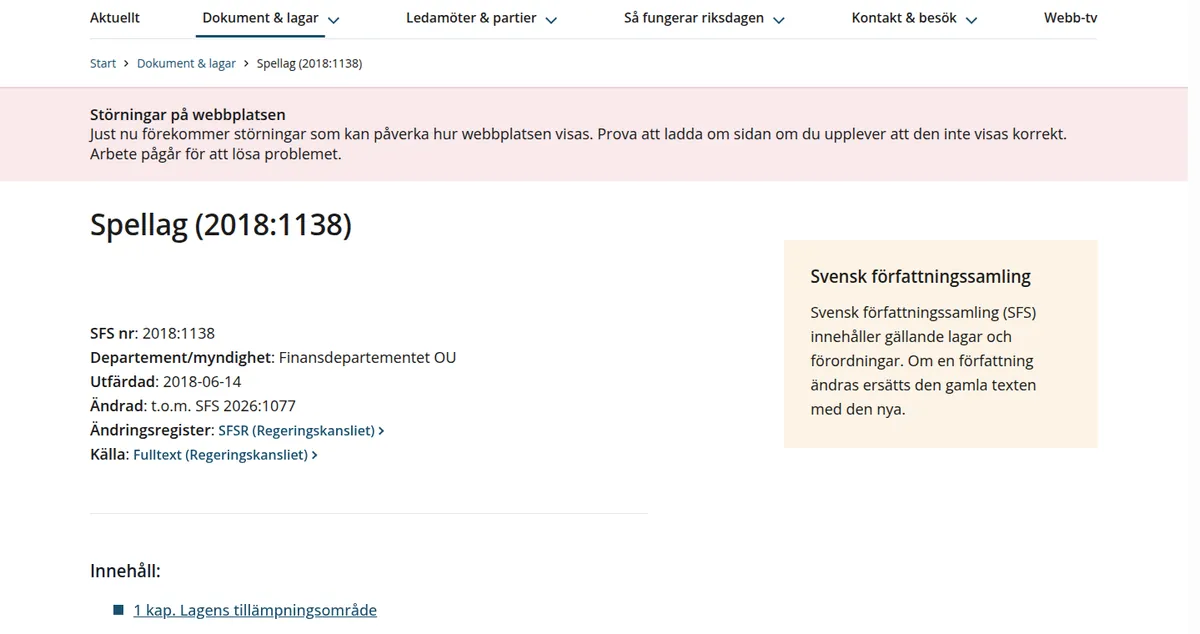
The text we worked from is the consolidated wording under SFS 2026:90, in force since 1 May 2026. This is where Chapter 19 on unlawful gambling operations sits, together with 14 kap. 12 § on self-exclusion and the two repealed sections in Chapter 18.
Two sections explain why this is a Swedish question
Forty thousand searches a month for a phrase describing what an operator lacks is unusual, and the explanation lies in two sentences in the Gambling Act.
The first is 14 kap. 9 §:
A licensee may offer or grant a bonus only on the first occasion on which a player plays any of the licensee’s games.
One bonus per player per licensee, once. The second is 14 kap. 12 §, which says that an exclusion registered with the gambling authority applies at every licensee, that is, at each operator holding a Swedish permit at the same time.
Both are drafted about the licensee. That means someone searching for something else is after a product that sits outside the circle the provisions are written about rather than a loophole — and that both protections fall away together. What the exclusion covers, and why that particular point carries the most weight, is dealt with on the page about how far Spelpaus reaches.
The most repeated claim about Swedish blocking is out of date
The first page of results for this question says over and over that since 2023 the authority has used two instruments: DNS blocking and payment blocking. We opened the statutes and found something else.
The power to ask a court to order a payment service provider to block transfers sat in 18 kap. 26–27 §§ of spellagen. In the current wording, what stands there instead is the line “26 § Repealed by lag (2023:309)”, and the same for section 27. The provisions had been applied zero times. A general ban on payment intermediation was considered in the same legislative process and left out.
What remains is an automatic refusal at card level, built on the merchant category code MCC 7995, and one single measure aimed at a website: the warning message in 18 kap. 28 §. Domain blocking of the kind Norway and Denmark operate is absent from Swedish law entirely. The ordinance text, the repealed section and the warning message are reproduced in full on the page about what the statute says.
The tax exemption hangs on two words rather than on the permit
A win is tax free under 8 kap. 3 § of the Income Tax Act if the gambling is provided in a state within the EEA and the gambling does not require a licence in Sweden. The second limb drops out of almost every Swedish summary of the question, and it is the limb that does the work.
If the exemption fails, 42 kap. 25 § says it must be declared once it exceeds 100 kronor, computed as the difference between total winnings and total stakes during the tax year with the same gambling provider. The rate on a surplus in the capital income category is 30 per cent under 65 kap. 7 §. The sections, the Tax Agency’s own list and the addresses to read them at are on the page about tax on winnings.
A permit inside the EEA and one outside are two different tax questions
The tax question is settled by the Income Tax Act rather than the Gambling Act, and it is settled by a single section with three alternative grounds. The first covers anyone licensed under spellagen. The second covers gambling that requires none at all, a lottery for charitable purposes for instance. For an operator without such a permit only the third is left: the win is tax free if the gambling is provided within a European Economic Area state and Swedish licensing is unnecessary for it.
The word “and” carries the whole sentence. Two limbs have to be satisfied at once, and almost every Swedish summary of the subject quotes only the first of them.
The EEA is the member states of the EU plus Norway, Iceland and Liechtenstein. Zero issuers appearing in our material belong there. Of 100 operators, 67 name a permit issuer: forty point to Curaçao, twenty-six to Anjouan and one to Mwali. None points to an EEA state.
That figure still leaves the question open, and this is precisely the distinction that tends to get lost. The provision asks where the gambling is provided, not where the permit was issued. The two often coincide while differing in kind, and either one resists conversion into the other.
The second limb then does the rest of the work. Online gambling directed at the Swedish market is regarded under 1 kap. 2 § of spellagen as provided here, which means Swedish licensing is required — at which point the second limb is no longer satisfied and the exemption falls, even for an operator sitting squarely inside the EEA with a permit from there. The shortcut that an EU permit means tax free therefore swaps one question for another and drops the third entirely. What the phrase EU casino can mean, and which four pieces of information an answer in an individual case would need, is on the page about EU casinos and Swedish licensing.
If the exemption fails, the win moves into the capital income category. 42 kap. 25 § says it must be declared once it exceeds 100 kronor, and that the amount is computed net per tax year and per gambling provider; the second paragraph also bars any deduction for gambling costs. The rate sits in 65 kap. 7 § and is thirty per cent of the surplus in the capital income category.
Two words in that sentence cost more work than they look. “The same gambling provider” means a loss with one row leaves a gain with another untouched, and that the provider is the company on the permit rather than the sign in the browser. Every row in the table carries its own company name, and two of the brands hold permits in two registers under a different name in each.
Finally, the calculation presupposes records. Inside the licensed circle they sit in a defined place: 13 kap. 3 § of spellagen requires that all transactions be kept available to the player for at least twelve months, which is exactly the period the tax calculation runs over. Outside that circle nothing equivalent appears in any of the ten agreements. That leaves open whether the operators hold such records; it means the document is silent — and that the records behind your own tax return are yours to keep. The sections word for word, the authority’s own list and the addresses to read them at are on the page about tax on winnings.
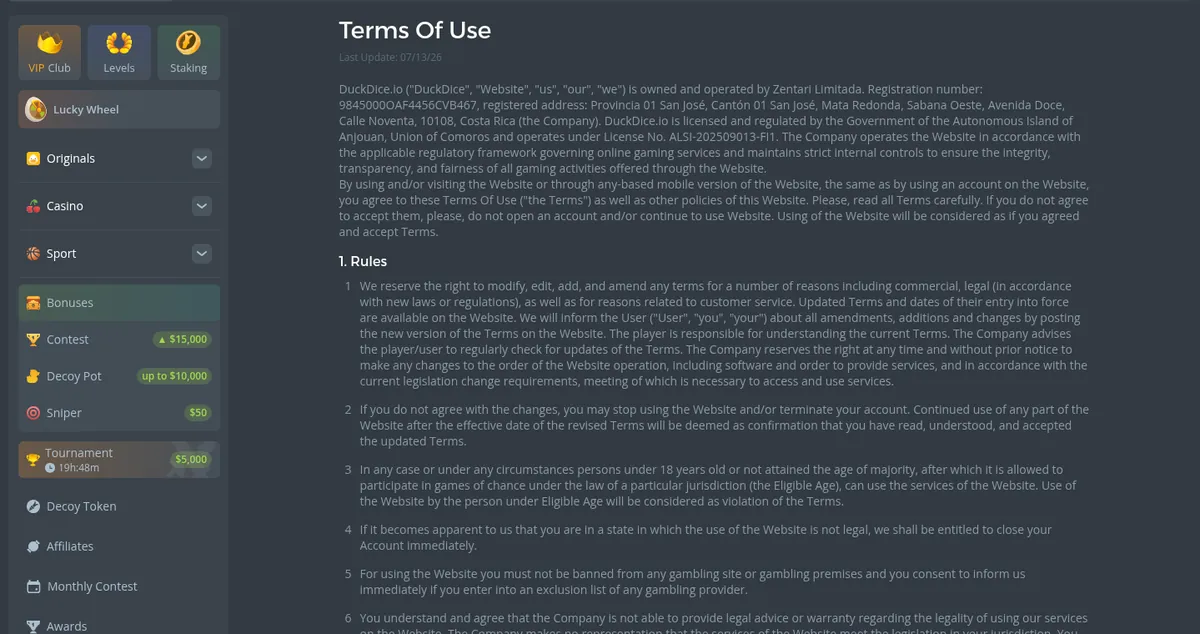
Section 2 frames verification as a judgement call: documents may be requested, with no amount named. The permit ALSI-202509013-FI1 appears in the public Anjouan register under Zentari Limitada, and the coin list runs to ten entries.
Nine permit numbers, two issuers, seven register hits
Five of the rows carry a number from Anjouan and four from Curaçao. Nine different company names sit behind them, and every name appears once.
A number shows that somebody has issued a permit. It says nothing about which court you end up in if there is a dispute, and nothing about Swedish law. In four of the nine cases the number in the footer differs from the number in the register, which is gone through on the page about offshore licences.
Both registers print the date the permit was granted, and the Anjouan one also prints when it expires. Nine such dates could be read, and they are the only measure of age that comes from somebody other than the operator itself. They are on the page about new casinos.
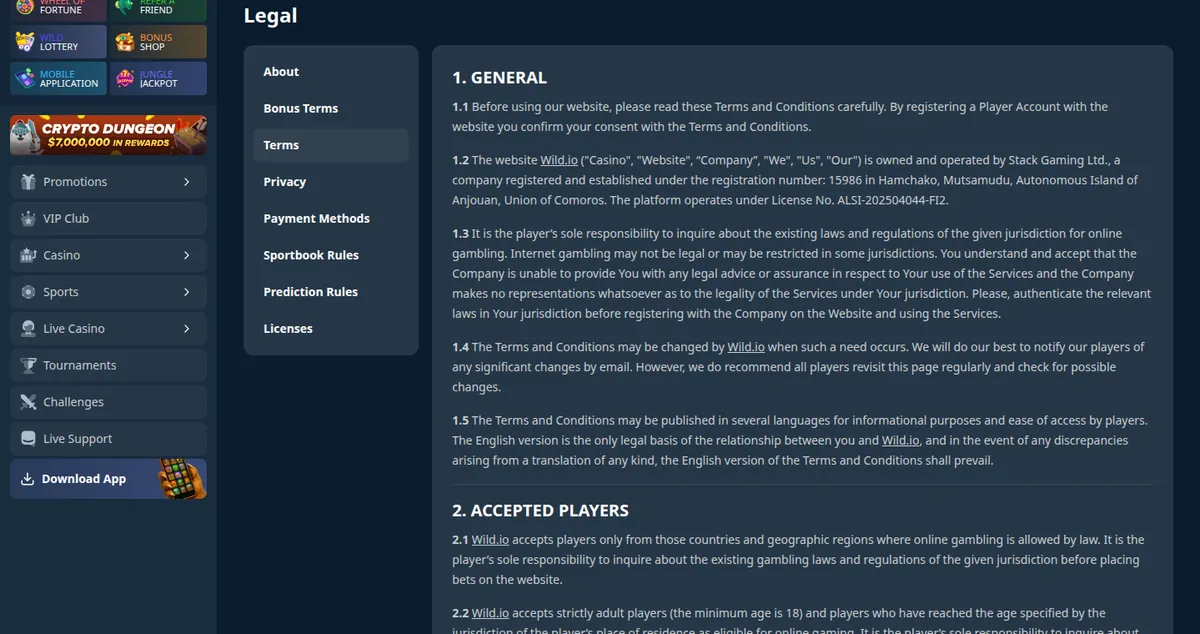
This is where the withdrawal cap of 100,000 USD per week in clause 9.6 comes from. We found the permit number OGL/2024/210/0198 in the Curaçao certificate register, and the company on the permit is Nonce Gaming B.V.
Three of ten name an amount for the identity check
Rocketpot writes 2,500 USD in clause 11.4, Bitcasino.io 2,500 EUR in clause 6.6 and Empire.io 2,000 USDT in clause 5.4. Six operators instead write that documents may be requested whenever the operator considers it necessary, lacking both amount and deadline.
Four operators also publish a cap on withdrawals: two counted per week, two per month, in three different currencies. Both pieces of information sit in the same part of the terms and bear on the same money, and they are set out together on the page about identity checks and withdrawals.
Payment routes: what the operators themselves name
Our material lacks a field for payment methods, which is why nothing here says that a given operator accepts Swish or Trustly. What can be read is what the terms themselves mention: DuckDice keeps a separate country list for card withdrawals in fiat, Metaspins writes in clause 12.5 that the maximum amount depends on the payment method chosen, and Wild Fortune’s monthly cap is listed in six currencies, none of them Swedish kronor.
In the other direction, what closes a Swedish payment route does so long before the cashier: a clause in the banks' own terms for Swish Handel, and two sections of the Gambling Ordinance drafted without a card in them. The bank terms are quoted word for word on the page about Swish, the register entry on the page about Trustly. And the question at the other end of the scale, the one about ten euros, is answered by none of the agreements — which is the subject of the page on minimum deposits.
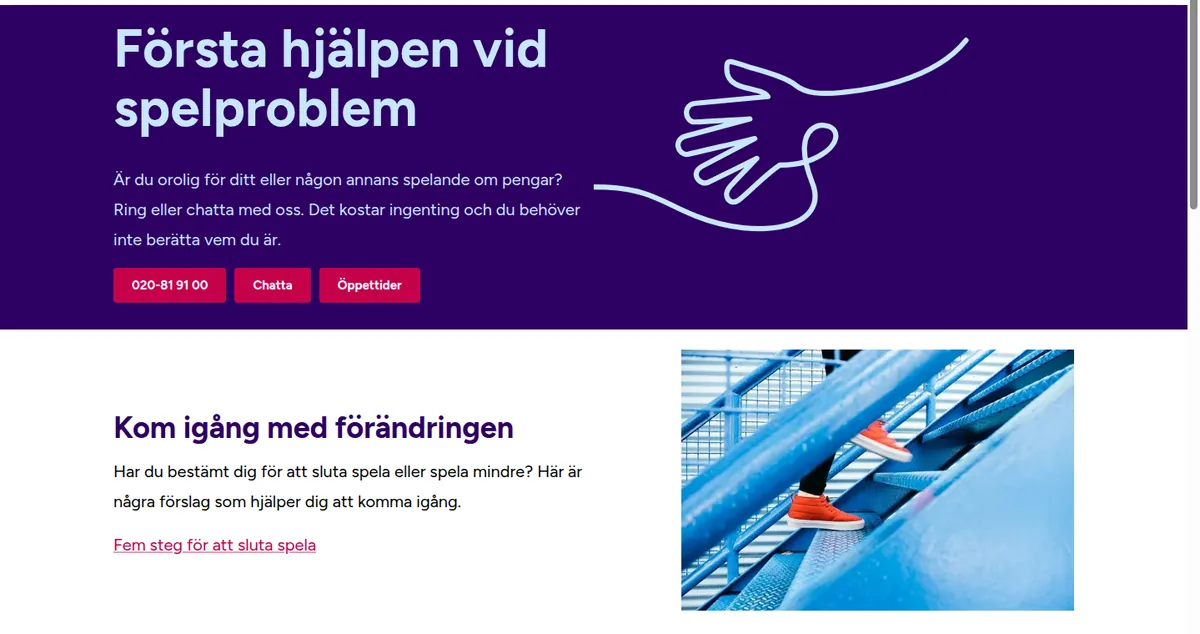
Free support on 020-81 91 00, with no ID required. Stödlinjen is run by Stockholms läns sjukvårdsområde with funding from the Public Health Agency of Sweden, which makes it a public service rather than an industry one.
Eight operators write themselves that they shut Swedes out
Our material holds 100 operators. The country list in the terms could be read for 38 of them, and eight of those lists include Sweden. Three of the eight share a permit number and a company name, which means three brands are one business.
That is the operators' own decision, set out in their own terms, rather than the result of any Swedish official decision. The names, the length of the lists and what the word foreign settles in Swedish law are on the page about offshore operators. What an online casino is in the meaning of the Act has a page of its own.
What an online casino unlicensed in Sweden falls outside
The difference between the two kinds of operator can be written without a single value judgement, by listing what the Gambling Act imposes on a permit holder. Seven duties, seven sections:
- Registration of the player before play, and only of a person resident or habitually present in Sweden (12 kap. 1 §).
- Identity established through a reliable electronic identification (12 kap. 2 §), and play held back until it is established (12 kap. 4 §).
- One gambling account per player, identification at every log-in and all transactions available to the player for at least twelve months (13 kap. 1–3 §§).
- An upper limit on deposits set by the player (14 kap. 7 §), per day, week and month under 11 kap. 3 § of the Gambling Ordinance.
- An age limit of 18 (14 kap. 2 §).
- All relevant information about the game available in Swedish (14 kap. 4 §).
- Connection to the exclusion register, since the exclusion has to apply at every licensee (14 kap. 12 §).
Every one of the seven is drafted about the licensee. An operator outside that circle is therefore caught by none of them, and what stands in their place is contract terms the operator wrote itself and can change itself. The sections are reproduced in full on the page about online casinos.
Note the direction of points 3 and 4. The statute requires that the player be able to see their own history and set a ceiling on what goes in. The terms in the table run the other way: four of the ten publish a ceiling on what may come out, set by the operator, and zero of the ten sets of terms we read mention transaction history.
What stands in place of the seven duties
None of the sections above has any counterpart outside the licensed circle, and what steps in instead is contract text the operator wrote itself. Set the two regimes side by side and the difference shows up point by point.
Identity. The statute puts the check before the first stake: 12 kap. 2 § requires a reliable electronic identification, and section 4 forbids play before identity is established. The agreements put it at the withdrawal. Three operators then state an amount with a clause number, and the other six write that the operator itself decides when documents are called for. The partner advertising here phrases it in clause 8.7 as a right to request documents before any withdrawal at all, and lists a selfie with ID, a selfie with a handwritten note, a phone call and a video call as acceptable forms.
The limit. 14 kap. 7 § requires the player to set a ceiling on their own deposits, and 11 kap. 3 § of the Gambling Ordinance requires that the ceiling be set per day, week and month, that a reduction take effect at once and an increase only after a further 72 hours. Such a tool is mentioned in none of the ten texts. Four instead publish a withdrawal cap, set by the operator, in three currencies and across two periods.
The history. 13 kap. 1–3 §§ require a gambling account, identification at every log-in and twelve months of available history. None of the texts mentions the subject.
The deadlines. This is where the imbalance is sharpest. The only deadlines we found in the material run against the customer: Rocketpot allows 30 calendar days for requested documents, and clause 8.7 of the advertising partner allows 14 days with account closure and forfeiture of winnings as the stated consequence if they fail to arrive. A deadline for the operator’s own handling appears in none of them.
The word forfeiture is worth pausing on. In the Gambling Act, forfeiture is a decision taken by a court and directed at a business. In the contract text we read it is a sanction the operator wrote into its own terms, and it lands on the customer’s money.
Language and currency. 14 kap. 4 § requires all relevant information about the game to be available in Swedish. A corresponding duty is missing outside the licensed circle, and every published amount in our material is denominated in USD, EUR or USDT. A balance measured in something other than what you count in carries an extra moving part, and it applies to the deposit as much as to the win.
The layout with amount, period and clause number for every row is on the page about identity checks and withdrawals.
Section 2 frames verification as a judgement call: documents may be requested, with no amount named. The permit ALSI-202509013-FI1 appears in the public Anjouan register under Zentari Limitada, and the coin list runs to ten entries.
Bonus rules: once under the statute, repeatedly under the terms
Of the seven duties, the bonus rule is the one that sets the Swedish permit apart from most others in Europe, and it fits in a single sentence. 14 kap. 9 § ties the offer to the customer’s very first round of play with the operator, and thereby closes off every later one.
Three things follow from the wording. A bonus may be given once only. The rule counts per permit rather than per brand. And the addressee is the licensee, which means the provision stops at exactly the same boundary as the exclusion register, for exactly the same reason.
Outside that circle such a limit is missing, and the difference shows best in a document we actually read. This site’s advertising partner publishes a welcome offer spread across four deposits — 150 per cent to a ceiling of 1.5 BTC with a hundred free spins, then 100 per cent capped at 1 BTC, 50 per cent capped at the same figure and 25 per cent up to 0.5 BTC — and alongside it a Thursday bonus of 100 per cent to a ceiling of 2,500 USDT, ten per cent of every deposit daily, a monthly slot race with 15,000 USDT and 15,000 free spins in the pot, and weekly cashback of up to seven per cent of net losses from VIP level 1. The figures are taken from the operator’s own promotion pages on 24 August 2026, and the link to the operator is an advertisement.
Read the list as a measure of the regulatory gap rather than as an offer. Every one of the five items is recurring, and a licensee is barred from granting a single one of them after the first occasion.
The figure that would settle what that particular package is worth is missing from our reading of that operator: the wagering requirement. The field is empty on the advertising partner’s row, and empty means unread — which is something other than zero and something other than free. We know neither the multiple that would apply, nor whether it would attach to the bonus, to the deposit or to both, nor whether a deadline runs. Five offers can therefore be listed, and the thing that settles what they cost cannot be worked out.
The loyalty programme can be worked out from the operator’s own figures. One point is given per 30 dollars wagered, only slots earn points, and 200 points are redeemed for a dollar. That comes to one dollar back per 6,000 dollars wagered, while table games and live tables earn nothing.
Four of the other nine rows do carry a multiple, read out of the operator’s own material. Rocketpot writes 100x in clause 9 of its bonus terms, adding that the figure holds unless an individual offer says otherwise; clauses 11, 12 and 13 count the house’s own games at a tenth and table games, live tables, video poker and sport at nothing. Bitcasino.io writes 30x in the terms attached to its promotion page, counted on the bonus money alone, with seven days to complete it, a highest permitted stake of 4 USDT and a smallest deposit of 50 USDT; slots count in full and live tables at a tenth. Rainbet writes 40x on the one of its two paths named after that figure, counted on deposit and bonus together. Wild.io stands in our material at 40x.
Three of those four figures carry no clause number, and that is said here rather than glossed over. Rocketpot’s 100x sits in a numbered clause; the 30x at Bitcasino.io, the 40x at Rainbet and the 40x at Wild.io sit in the operators’ own promotional text, read on 2 September 2026, with no numbered clause to point at. A figure without a clause number weighs less than one with, and is not mixed in with it.
At the five remaining rows an empty field means unread and nothing else. At three of them — Wild Fortune, Metaspins and Wolf.bet — the bonus page was read and carried no multiple on it, and at two the bonus terms were never opened. An empty field is never a statement that no requirement exists. What a Swedish permit compels an operator to do in return, section by section, is on the page about online casinos. What the advertising partner publishes about its permit, withdrawals and checks is set out clause by clause in the review of Vave.
The table against the whole sample: how rare a stated figure is
The ten rows are drawn from a collection of 100 operators, and that collection shows how unusual each individual item is.
- 67 of 100 name a permit issuer. Thirty-three leave it out.
- 51 of 100 spell out a company name on the permit.
- 29 of 100 publish a list of coins accepted.
- 38 of 100 have a country list in the terms that could be read in full.
- 26 of 100 cite a clause number for their verification wording.
- 11 of 100 state a founding year.
- 5 of 100 spell out the amount at which documents are requested.
- 14 of 100 publish a cap on withdrawals.
The last two lines are the interesting ones. Three of the five that state an amount are in the table here, and four of the fourteen that publish a cap are too. That follows from a selection made on how much could be documented rather than on generosity — and those two items carry double weight in that measure, for reasons set out on the page about the measure behind a top list.
Then there is how the texts were obtained. Of the 100, 37 were read directly, 41 in an archived copy and 22 yielded nothing readable at all. In other words: rather more than a fifth of the collection is blank rows, and they stay blank rather than being filled from anyone else’s summary.
Sweden appears on eight lists, Norway on none
The 38 country lists we could read in full name a couple of hundred countries between them, and the distribution is lopsided. The United States appears on 32 of the lists, the United Kingdom on 29 and the Netherlands on 27 — the most excluded country within the EEA by a wide margin. Spain appears on 24 and France on 23.
The Nordics look different. Sweden appears on 8 of the 38 lists, Iceland on 7, Denmark on 2, Finland on 1 and Norway on none at all.
That is worth pausing on. Norway has both a state monopoly and blocking of the kind Swedish law lacks, and still appears on none of the country lists we read. Sweden, which leaves domains and account transfers alike unblocked, appears on eight. The lists therefore track something other than how strictly a country behaves towards operators, and anyone reading a country list as a measure of the legal position is reading the wrong document. The names of the eight, the length of their lists and what they have in common are on the page about operators abroad.
Seven coin lists, and why the count falls short of a grade
Seven of the ten publish a list of the coins they accept. Rocketpot and Wolf.bet name 13 each, Wild.io 12, Wild Fortune and DuckDice 10, Rainbet 9 and Metaspins 8. For Bitcasino.io, Empire.io and the tenth row we lack a list we could read, and that is a gap rather than a small range.
Two names appear on all seven lists, bitcoin and ether. Five more appear on six of the seven: bitcoin cash, litecoin, tron, ripple and tether. The rest is the tail, and that is where the rows differ: DuckDice is the only one to name monero, and Wolf.bet the only one to include polkadot, optimism, shiba inu and ton.
Rocketpot’s list shows at the same time why the number should be read carefully. Two of its thirteen entries are tether in two forms, on two different chains, and counting them as two makes the list one entry longer than counting them as one. We have left the entries as the operator wrote them and say plainly why the figure therefore resists exact comparison between rows.
A longer count means more entries on a list rather than a better operator or lower fees. What a measure has to satisfy before it means anything is tested on the page about what the word best would need to rest on.
The same terms text sits behind several signs
A row in a table looks like a company. In the material it is sometimes a sign, and three observations in the collection of 100 show it.
Three brands state the same amount in the same currency under the same clause number: Bitcasino.io, Sportsbet.io and Livecasino.io all write 2,500 EUR in clause 6.6. An identical figure in an identical place in a document arises by design rather than by itself.
Three others — Oshi Casino, PlayAmo and Slotum — share both a company name and a permit number, Novatrix SRL with ALSI-202508056-FI2. Yet the three publish three different withdrawal caps: 4,000 euros per day, 7,500 euros per week and 15,000 in euros or dollars per week. Same company, same permit, three different sets of terms for the money going out.
And two brands, 7Bit Casino and Mirax, carry the same Curaçao number under different company names in our notes.
We leave uninvestigated what any of the three observations is due to, and we therefore draw zero conclusions about who owns what. The practical point is simple: moving between two signs may well leave the counterparty unchanged, and the counterparty is the name on the permit. The names behind the rows are set out on the page about offshore licences.
Free support on 020-81 91 00, with no ID required. Stödlinjen is run by Stockholms läns sjukvårdsområde with funding from the Public Health Agency of Sweden, which makes it a public service rather than an industry one.
Six supplier lists, 182 names
Six of the ten publish their own list of game suppliers: Bitcasino.io names 120, Wild.io 80, Empire.io 79, Rainbet 33, Wolf.bet 32 and DuckDice 19.
Merge the six lists and compare name against name and you get 182 distinct suppliers. Of those, 85 — almost half — appear on a single list. Six names appear on all six: BGaming, PG Soft, Pragmatic Play, Spinomenal, Evolution and Hacksaw.
The last two names show at once why the figures should be read as lower bounds. Evolution appears as Evolution on five lists and as Evolution Gaming on the sixth; Hacksaw appears as Hacksaw at one operator and Hacksaw Gaming at five. Two spellings of the same studio count as two entries in a straight tally, and there are more such pairs in the material. What the count is good for as a measure, and where it stops, is described on the page about the measure behind a top list.
Six words that mean different things in the statute and in the marketing
Much of the confusion in this subject is vocabulary, and six words account for most of it.
Foreign. The Gambling Act lacks the category. 1 kap. 2 § asks two other questions: where the gambling is offered, and which market it is directed at. Where the company is based is absent from the section. The word therefore settles nothing on its own, which is the whole subject of the page about foreign casinos.
Online casino. The Swedish word nätcasino occurs zero times in the Gambling Act or the Gambling Ordinance. The statute works instead with online gambling, defined in 2 kap. 1 §, and gathers roulette, dice and cards under casino games in 2 kap. 3 §.
Licence. In the footer of two of the operators, the figure means something other than it appears to. Rocketpot’s terms call 1668/JAZ a registration number while the front page calls the same figure a gambling licence, and Rainbet’s terms give the company registration number 16077 without setting out a permit number anywhere. A company register and a gambling permit are two different registers.
Bonus. Inside the licensed circle the word is regulated and counted per permit, once per player. Outside it, it is a marketing word empty of legal content, and the thing that settles what an offer is worth — the wagering requirement — sits in the small print rather than in the headline.
Tax free. The expression describes a win rather than an operator. A supplier cannot make a win tax free by writing so on its own site; the question turns on where the gambling is offered and on whether Swedish licensing is required for it.
Block. What remains in Swedish law is one measure that reaches a website, the message under 18 kap. 28 §, plus the merchant-code rule. The court-ordered payment block was repealed in 2023 without ever having been applied, and domain blocking on the Norwegian or Danish model has always been absent here.
Six words, six different sources to look up. The common thread is that the marketing vocabulary is almost always broader than the statutory one, and that the gap sits exactly where a reader believes they have been given an answer.
The ten rows, one sentence each
Each row has a page of its own where the permit detail, the verification clause and the withdrawal term appear with their numbers beside them, together with what is missing from the document. The rows below are ordered as in the table.
- Vave — the advertising partner behind this site, with the Curaçao permit OGL/2024/1676/0905 held by Latcas B.V. and a verification clause that applies before any withdrawal at all.
- Rocketpot — the only row that both states an amount for the identity check and spells out how many days you have, and the only one whose terms give two different amounts.
- Bitcasino.io — the highest published withdrawal cap in the table, and a permit number written one way in the help section and another in the anti-money-laundering policy.
- Wild Fortune — the only row that puts the identity check before play rather than before the withdrawal.
- DuckDice — a short country list, a permit expiring on 15 September 2026 and a separate country list for card withdrawals in fiat.
- Empire.io — 2,000 USDT in clause 5.4, and a register entry in which the validity period and the status contradict each other.
- Metaspins — the freshest permit in the table and the wording that commits the operator to least: a check once play reaches a certain level, with the level left unstated.
- Rainbet — the fullest account of which documents are requested, and two of its own documents describing the check differently.
- Wild.io — two withdrawal caps rather than one, and two permits issued seven days apart to two different company names.
- Wolf.bet — the longest coin list together with Rocketpot, a permit number that returned nothing from the register and a country list that calls itself incomplete.
The pages carry zero rankings and zero scores. They report what the operator published, with clause numbers, and set out what eluded us.
Where the question is actually settled, and by whom
Four Swedish bodies come up in this discussion, and they settle four different things. Keeping them apart is the fastest way to see why one answer rarely follows from another.
Spelinspektionen supervises under the Gambling Act. Its instruments are injunctions or prohibitions under 18 kap. 23–25 §§, which may carry a conditional fine, financial penalties under 19 kap. 10 §, and since the summer of 2023 undercover test purchases. All three are addressed to the operator, and none of them removes a domain or stops a transfer.
Skatteverket settles the tax, and does so without consulting any permit register. The assessment turns on where the gambling is provided and whether Swedish licensing is required, that is, on two matters missing from every register entry. A permit number therefore leaves the tax question unanswered even in part.
Finansinspektionen supervises payment service firms. That Trustly Group AB appears in the company register as a payment institution says something about Trustly and nothing about which merchants it serves; the register lacks such a list, which is explained on the page about Trustly.
The bank in practice settles the Swedish payment route, and does so in its own contract with its business customer. The clause excluding gambling without the necessary permits sits in the terms for Swish Handel rather than in a statute, and it can be changed by the bank without any section being amended. The wording used by two banks is on the page about Swish.
The fifth decision-maker sits outside the public sector entirely. The terms you accept settle the amounts, the deadlines, the withdrawal cap and which counterparty a dispute is brought against, and they are written by the operator and can be changed by the operator. That is why these pages cite clause numbers rather than summarise: a clause can be looked up and someone can be held to it, a summary cannot. The routine behind the reading is on the page about how we read the documents.
Fifteen questions, answered from the source
Can I be punished as a player for staking money with an unlicensed operator?
When is a gambling win tax free?
Above what amount does a taxable win have to be declared?
What does Skatteverket itself say about it?
Does my Spelpaus exclusion apply at an operator without a Swedish permit?
Why may a licensed operator offer a bonus only once?
Do Swedish authorities block sites or payments?
Who supervises this, and who is the supervision aimed at?
Does a permit from Curaçao or Anjouan mean the operator may accept Swedish players?
Do I have to identify myself before the money is paid out?
Is there a ceiling on how much I can withdraw?
Can I pay with Swish?
Is Trustly a way around the card-code rule?
How should an empty cell in the table be read?
Have you played at the operators in the table?
The page of questions and answers takes ten more, among them what happens when a permit expires and how unusual it is for an operator to spell out an amount.
What is missing here
Star ratings and a top list assembled on feel are both absent. Zero sentences begin with the claim that we tested anything: this site lacks an account with all of the operators and has deposited nothing. What a word like best would need to rest on before it meant anything is on the page about what the measure is.
An empty cell in the table means the information is missing from the terms. Something other than zero, and something other than an open limit. An unstated withdrawal cap read as the absence of a cap turns a gap into an advantage for the operator, which amounts to inventing the figure. How we obtain, date and correct material is set out on the page about how we read the documents, and twenty-five recurring questions are answered with a section, a clause number or a count on the page of questions and answers.
If you need to talk to someone about your own gambling, Stödlinjen answers on 020–81 91 00. The call is free and identification is unnecessary.