
The statute plus the authority’s own page
Tax free rests on two conditions at once, rather than one
8 kap. 3 § of the Income Tax Act makes a gambling win tax free on 3 alternative grounds. The ground that deals with the EEA has two limbs, and Skatteverket spells out the same two limbs on its own page about gambling winnings.
The section that settles it, word for word
The question is settled by inkomstskattelagen (1999:1229), the Income Tax Act, rather than by the Gambling Act. The provision sits in Chapter 8, among the income that is not to be taken up, and reads in its wording under lag (2018:2039):
3 § Winnings from lotteries and combination games and from betting are tax free if - the game is provided by someone who holds a licence under the Gambling Act (2018:1138) and the game requires a licence under that Act, - the game is provided in Sweden and the game does not require a licence under the Gambling Act, or - the game is provided in a state within the European Economic Area (EEA) and the game does not require a licence in Sweden.
Three points, and it is enough that one of them fits. The first covers licensees, which is precisely what an unlicensed operator lacks. The second covers games that require none at all, a lottery for charitable purposes for instance. What is left for our question is the third.
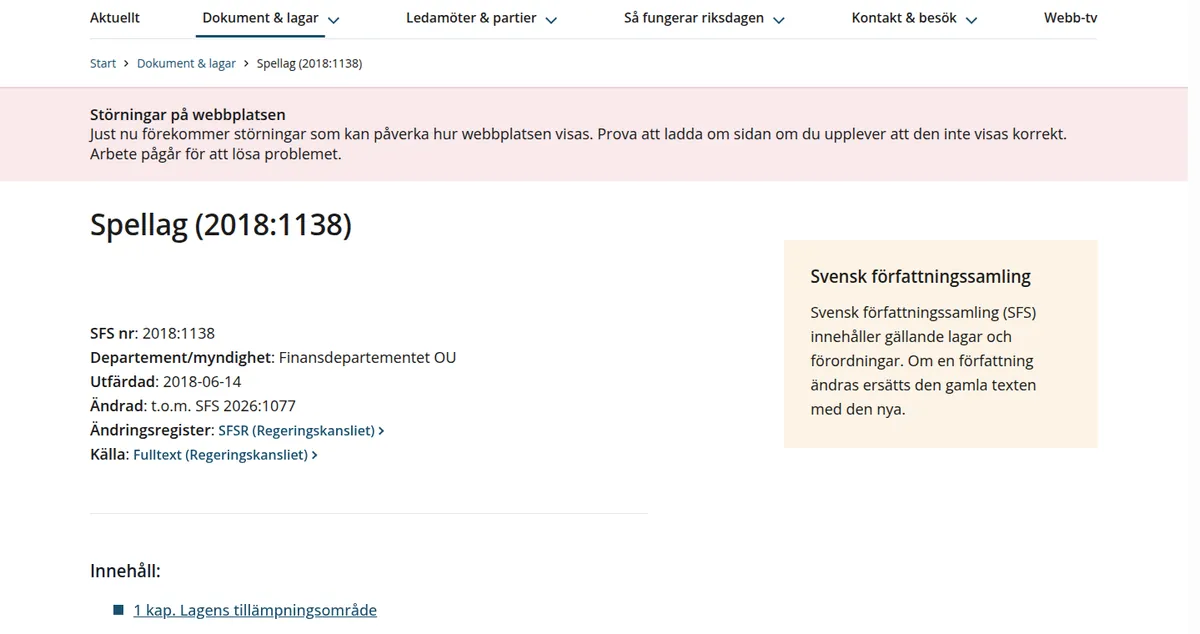
The text we worked from is the consolidated wording under SFS 2026:90, in force since 1 May 2026. This is where Chapter 19 on unlawful gambling operations sits, together with 14 kap. 12 § on self-exclusion and the two repealed sections in Chapter 18.
The third point has two limbs rather than one
Read it slowly. The game must be provided in a state within the EEA, and a Swedish licence must be unnecessary for it. Both limbs have to be satisfied at the same time, because they are joined by the word “and”.
The second limb points back at the Gambling Act, where 1 kap. 2 § says:
2 § The Act shall apply to gambling provided in Sweden, unless otherwise follows from sections 3, 4 or 5. Online gambling that is not directed at the Swedish market shall not be regarded as provided in Sweden.
The sentences therefore interlock backwards. Online gambling directed at this market is regarded as provided here, and then the Gambling Act requires a licence. If it is, the second limb of the tax provision fails, and the exemption falls with it even if the operator sits squarely inside the EEA.
The usual summary — “an EU permit means tax free” — loses both halves. It swaps where the game is provided for where the permit was issued, and it drops the condition about Swedish licensing altogether. What the phrase EU casino otherwise carries with it, and which four pieces of information a decision on an individual row would need, is dealt with on the page about EU casinos and Swedish licensing.
The authority spells out the same thing
The reading above is ours, but it stands alongside the authority’s own. Skatteverket has its own page on winnings from gambling and competitions, read on 1 September 2026, listing when a win has to be declared. The first item on that list reads:
gambling that is directed at the Swedish gambling market and requires a licence in Sweden, but the gambling provider holds no Swedish gambling licence
The other three items on the list cover online gambling not specifically directed at a market within the EEA, gambling physically provided outside the EEA, and winnings from a pyramid scheme. The authority’s corresponding list of tax-free winnings covers values of 100 kronor or less, gambling where licensing is required and the provider holds it, and gambling where none is required. Both lists can be read in full at the address at the foot of this page.
That the authority’s own account and the statutory text point the same way is worth noting in this particular question, because it is unusual in the summaries that otherwise dominate the search results.
What applies when the exemption fails
It then moves into the capital income category. 42 kap. 25 § of the Income Tax Act, in its wording under lag (2018:1143):
25 § Winnings from lotteries, combination games and pyramid schemes and from betting shall be taken up if the winnings exceed 100 kronor and are not tax free under 8 kap. 3 §. The winnings to be taken up are computed as the difference between total winnings and total stakes during the tax year with the same gambling provider. Costs of taking part in lotteries, combination games, betting and pyramid schemes may not be deducted.
Three things to note. The amount is computed net: total winnings minus total stakes. The net is computed per tax year and with the same gambling provider. And the second paragraph closes the door on deductions: whoever ends up down cannot deduct anything at all.
The rate sits in 65 kap. 7 §: for natural persons, the state income tax on capital income is 30 per cent of the surplus in the capital income category.
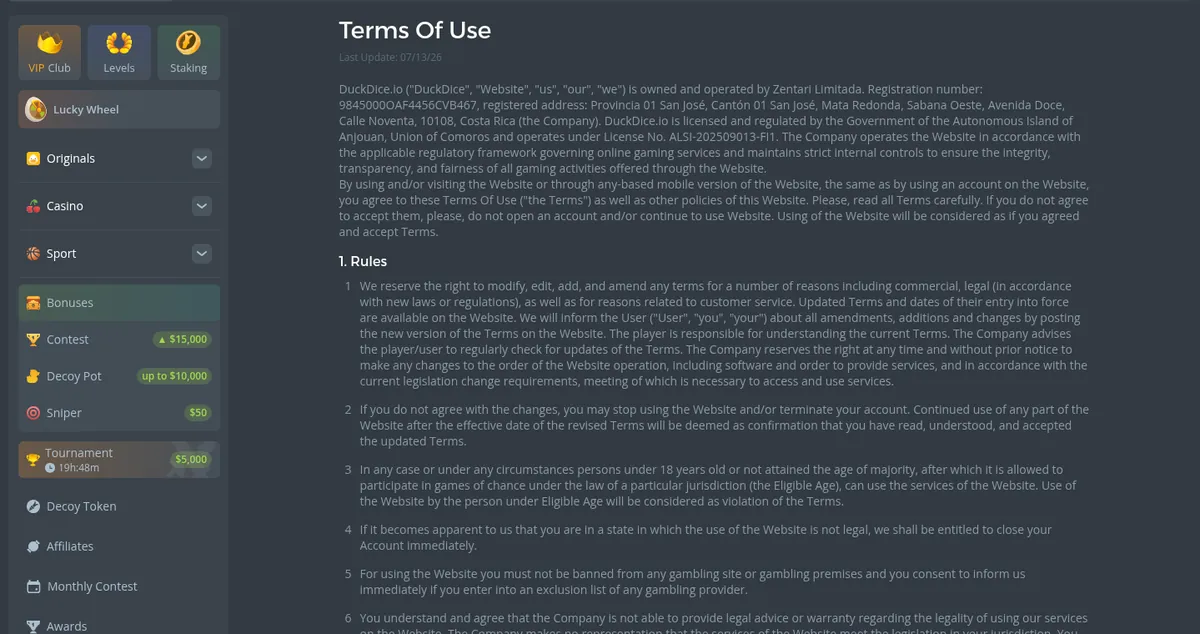
Section 2 frames verification as a judgement call: documents may be requested, with no amount named. The permit ALSI-202509013-FI1 appears in the public Anjouan register under Zentari Limitada, and the coin list runs to ten entries.
What the words “the same gambling provider” do to the calculation
The word “same” carries more than it looks. Setting off happens within one provider and one tax year, rather than between providers. A loss with one row therefore leaves a gain with another untouched in the computation under the second sentence of the section.
That turns the question of who the provider is into a question about figures rather than only about contracts. A brand may well fall short of being a provider: in our material, three of the operators that exclude Swedish customers share one and the same permit number and company name, and two of the ten in the table carry two permits with a different company name in each register. Which name sits behind which brand is set out on the page about offshore licences.
We apply the section to zero individual cases and compute nobody’s win. What is set out here is what the sentence says, word by word, and who decides how it is applied is two sections further down.
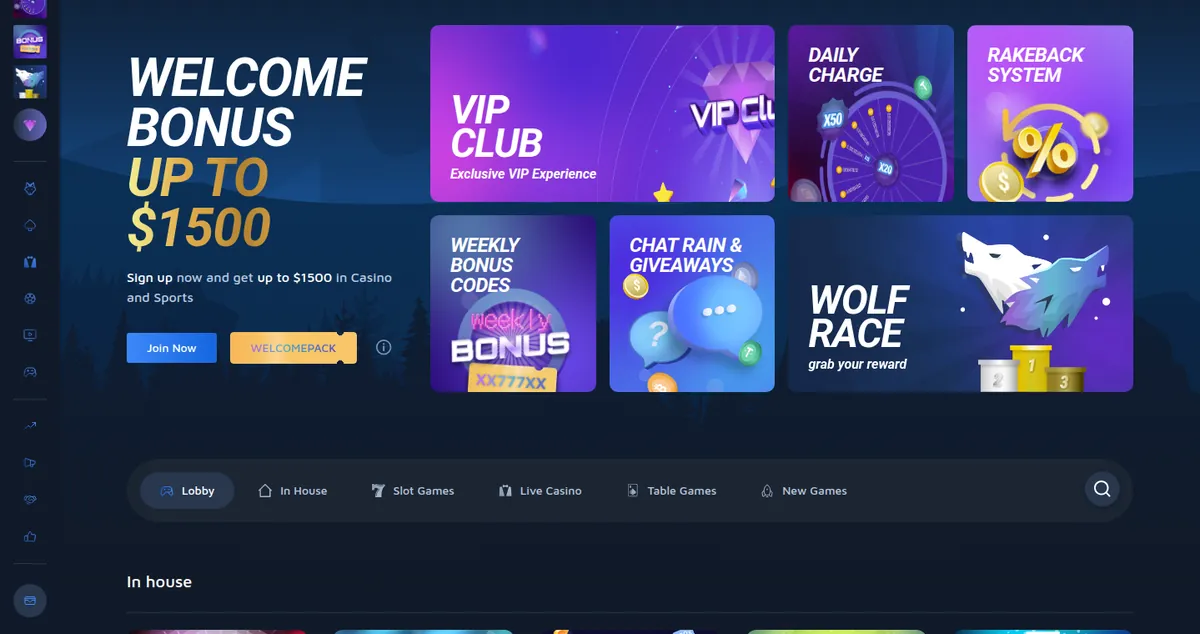
One of the two longest coin lists in the table: thirteen coins, with usdt and usdc among the six given prominence. We read the permit number ALSI-132405048-FI3 here, on the operator’s own page rather than in the Anjouan register; the company behind the brand is Cipher Games Ltd.
What the calculation requires of you in practice
The second sentence of the section describes an arithmetical operation, and that operation presupposes records somebody has kept. The difference between total winnings and total stakes during a tax year with the same gambling provider cannot be reconstructed from memory.
Inside the licensed circle those records sit in a defined place. Chapter 13 of spellagen requires a gambling account for every registered player (section 1), identification at every log-in (section 2) and that all transactions be recorded and kept available to the player for at least twelve months (section 3). The tax year is twelve months, so the requirement in section 3 covers exactly the period 42 kap. 25 § runs over.
Outside the licensed circle such a provision is missing, and none of the ten sets of terms we read mentions transaction history at all. That leaves open whether the operators keep any; it means the documents say nothing on the point, which is the rule this whole site is built on. What the terms do spell out is caps and verification thresholds, and those appear with clause numbers on the page about identity checks and withdrawals.
Two things follow. The records behind a computation under 42 kap. 25 § are yours to keep, and they must be kept per gambling provider rather than per account or per brand. Who the provider is turns on the company name on the permit rather than on the sign in the browser.
The second limb cannot be answered with a permit number
The exemption under the third point requires the gambling to be provided within the EEA. Our material holds 67 statements about who issued a permit, and none of the issuers belongs to the EEA. That figure still leaves the question open, and it is worth being clear about why.
The point asks where the gambling is provided, that is, where it is offered. The permit detail answers where a permit was issued. An operator could in principle be established in an EEA state and hold a permit issued somewhere else, and the reverse is equally conceivable. The two often coincide though hardly always, and either one resists conversion into the other.
What would answer the question is information we lack: where the business is actually carried on and which market it turns to. The second limb, which requires Swedish licensing to be unnecessary, is moreover tied to 1 kap. 2 § of spellagen and turns on whether the online gambling is directed here — an assessment Skatteverket and ultimately a court makes, rather than a field in a register entry.
That is why nothing on this page says that a win at any of the ten operators is tax free or taxable. We reproduce the sections that settle the question and point out what would be needed to answer it in an individual case.
One of the two longest coin lists in the table: thirteen coins, with usdt and usdc among the six given prominence. We read the permit number ALSI-132405048-FI3 here, on the operator’s own page rather than in the Anjouan register; the company behind the brand is Cipher Games Ltd.
What a permit number leaves unanswered
The tax provision asks where the gambling is provided and which market it turns to. The permit number answers where a permit was issued, and one cannot be converted into the other.
Nine of the ten operators in the table state a number, all of them from Curaçao or Anjouan, and both jurisdictions lie outside the EEA. The same holds for the whole sample: of 100 operators, 67 name an issuer, forty point to Curaçao, twenty-six to Anjouan and one to Mwali. None of them lies within the EEA. The underlying figures are on the page about offshore operators.
A number also says nothing about what the terms require of you before the money is paid out; that appears with clause numbers on the page about identity checks and withdrawals.
Where you can read it for yourself
The Income Tax Act (1999:1229) is available in full at riksdagen.se, with the amendment history of every section: 8 kap. 3 §, 42 kap. 25 § and 65 kap. 7 § in their current wording. Our reading was made on 1 September 2026 in the consolidated text, amended up to SFS 2026:1393. The Gambling Act sits in the same collection, in the wording under SFS 2026:90.
The authority’s own account is on Skatteverket’s page about winnings from gambling and competitions, read the same day.
It is worth opening both in turn. The statute gives the wording and the authority’s page gives the application in bullet form, and it is when the two are read side by side that the second limb of the EEA point becomes hard to miss.
Where this page stops
It is a reading of the sources rather than tax advice or a ruling in your case. It reproduces three statutory sections and one authority page, with dates, so that you can look them up yourself and see that they say what we claim they say. The assessment in an individual case is made by Skatteverket, and it can land differently from a reading of the statute at the kitchen table.
The page also says nothing about how a tax might be reduced, deferred or avoided. If the win falls under 42 kap. 25 § it has to be declared, and anyone unsure asks Skatteverket before filing the return rather than after.
The penal provisions are a separate question and leave this one unanswered. What Chapter 19 of spellagen covers is on the page about what the statute says, and the payment route leaves the tax untouched, as the page about Swish makes clear.