
Read in the issuer’s register
Nine numbers, seven register hits and four mismatches
9 of the 10 operators in the table state a permit number. Seven could be found in the issuer’s own register, two appeared only in the operator’s own documents — and in four cases the number on the site differs from the number in the register.
| Operator | Licence | Coins | Before ID check | Open |
|---|---|---|---|---|
| Rocketpot | Curacao | 13 | US$2,500 | Go to the casino siteRead |
| Bitcasino.io | Curaçao Gaming Authority | 12 | 2,500 EUR | Go to the casino siteRead |
| Wild Fortune | Anjouan Gaming Board | 10 | case by case | Go to the casino siteRead |
| DuckDice | Anjouan Gaming Board | 10 | case by case | Go to the casino siteRead |
| Empire.io | Anjouan Gaming Board | not read | 2,000 USDT | Go to the casino siteRead |
| Metaspins | Curaçao Gaming Authority | 9+ | case by case | Go to the casino siteRead |
| Rainbet | Anjouan Gaming Board | 9+ | case by case | Go to the casino siteRead |
| Wild.io | Curaçao Gaming Authority | 12 | case by case | Go to the casino siteRead |
| Wolf.bet | Government of the Autonomous Island of Anjouan, Union of Comoros | 32 | case by case | Go to the casino siteRead |


The two issuers, and what the numbers look like
The numbers in the table come in two formats, and the format gives away the issuer.
Curaçao writes OGL/year/serial/serial. Four operators carry such a number: Bitcasino.io with OGL/2023/111/0069, Metaspins with OGL/2024/1063/0437 and Wild.io with OGL/2024/210/0198, all three with status Active in the register, plus Rocketpot with 1668/JAZ, which belongs to the older series.
Anjouan writes ALSI-digits-FI-digit. Five operators carry such a number:
- Wild Fortune — ALSI-202509073-FI2, issued to Metlait SRL.
- DuckDice — ALSI-202509013-FI1, issued to Zentari Limitada.
- Empire.io — ALSI-132405042-FI3, issued to Pixel Entertainment Limited.
- Rainbet — ALSI-152406029-FI2, issued to RBGAMING N.V.
- Wolf.bet — ALSI-132405048-FI3, issued to Cipher Games Ltd.
Nine numbers, nine different company names. Zero names recur on two rows — unlike among the operators that exclude Swedish customers, where three brands share both number and company, as set out on the page about offshore operators.
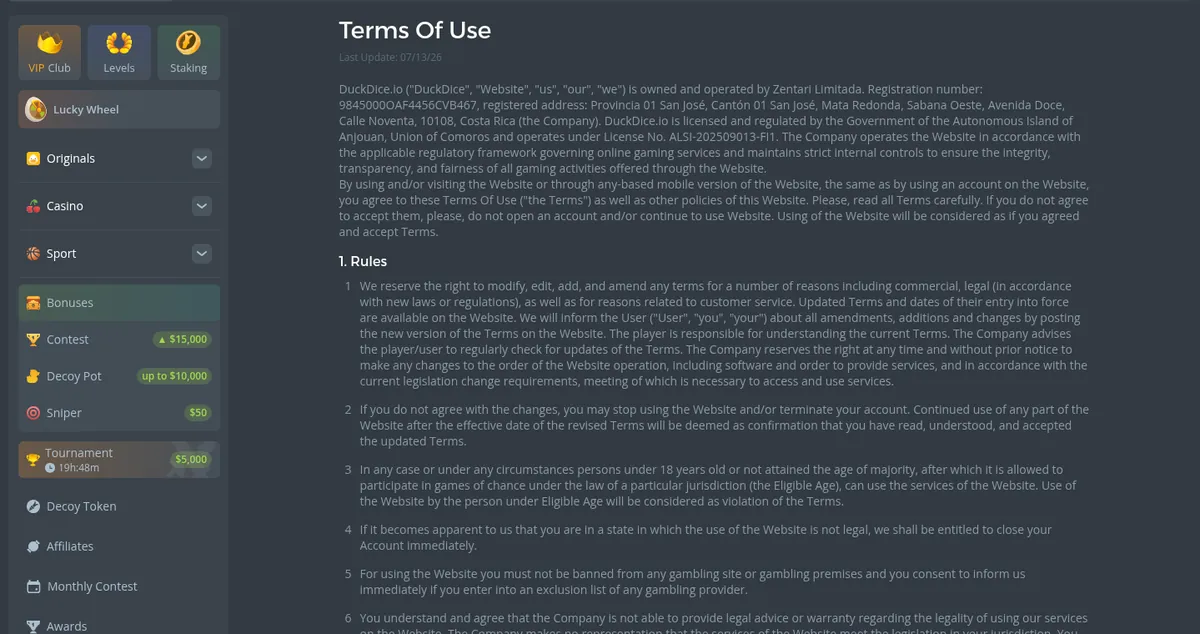
Section 2 frames verification as a judgement call: documents may be requested, with no amount named. The permit ALSI-202509013-FI1 appears in the public Anjouan register under Zentari Limitada, and the coin list runs to ten entries.
Where we found the number matters
A number printed in a footer is a claim by the operator. A number that can be looked up at the issuer is a statement by the issuer. Those are two different things, and we record which of them we have.
Curaçao certificates are looked up through the authority’s certificate register, where every hit has an address of its own. There we found Bitcasino.io, Metaspins and Wild.io. Rocketpot’s number 1668/JAZ, by contrast, we found only in the operator’s own terms.
The public Anjouan permit register returned hits for Wild Fortune, DuckDice, Empire.io and Rainbet. Wolf.bet’s number we read on the operator’s own front page.
Two of nine numbers therefore rest on the operator’s word. That leaves them unconfirmed rather than false, and the difference is invisible in a table that only prints the figure.
Four operators write a different number from the register
This is the single commonest discrepancy in the material, and it is easy to misread.
Wild.io writes ALSI-202504044-FI2 on its own site, while the Curaçao certificate register answers with OGL/2024/210/0198. Metaspins writes ALSI-202606048-FI2 while the certificate reads OGL/2024/1063/0437. For both, the explanation is simple and checkable: they hold two permits, one in each jurisdiction, with a different company name on each. The dates are on the page about new casinos.
Wild Fortune writes the number 0000064 on its site while the Anjouan register lists ALSI-202509073-FI2. The operator also carries a company registration number in Costa Rica, 3-102-911867, which is something else entirely from a gambling permit.
Bitcasino.io gives OGL/2023/111/0069 on the front page and in the help section, but its anti-money-laundering policy instead states the number 1668/JAZ and names the Curaçao Gaming Control Board as supervisory authority. That number therefore appears in the documents of two of the ten operators, since Rocketpot gives the same series in its terms. What it is due to we have left uninvestigated, and we draw zero conclusions from it.
The point of listing the discrepancies lies elsewhere than in proving anything about the operators. The point is that somebody who tries one of two numbers and gets nothing back has thereby shown nothing at all.
Two numbers described as something other than licences
Two rows deserve a second reading, because the figure there carries a name other than the one you would assume.
Rocketpot writes in its terms that the company is owned and operated by Danneskjold Ventures B.V. under registration number 1668/JAZ and the laws of Curaçao. On the front page the same number is described as a gambling licence. A company register and a gambling permit are different things, and the documents disagree.
Rainbet gives the company registration number 16077 in its terms but a gambling permit number is missing there; the phrasing about being licensed in Anjouan can just as easily refer to the jurisdiction as to a particular permit. The number in our table, ALSI-152406029-FI2, comes from the Anjouan register rather than from the operator’s terms.
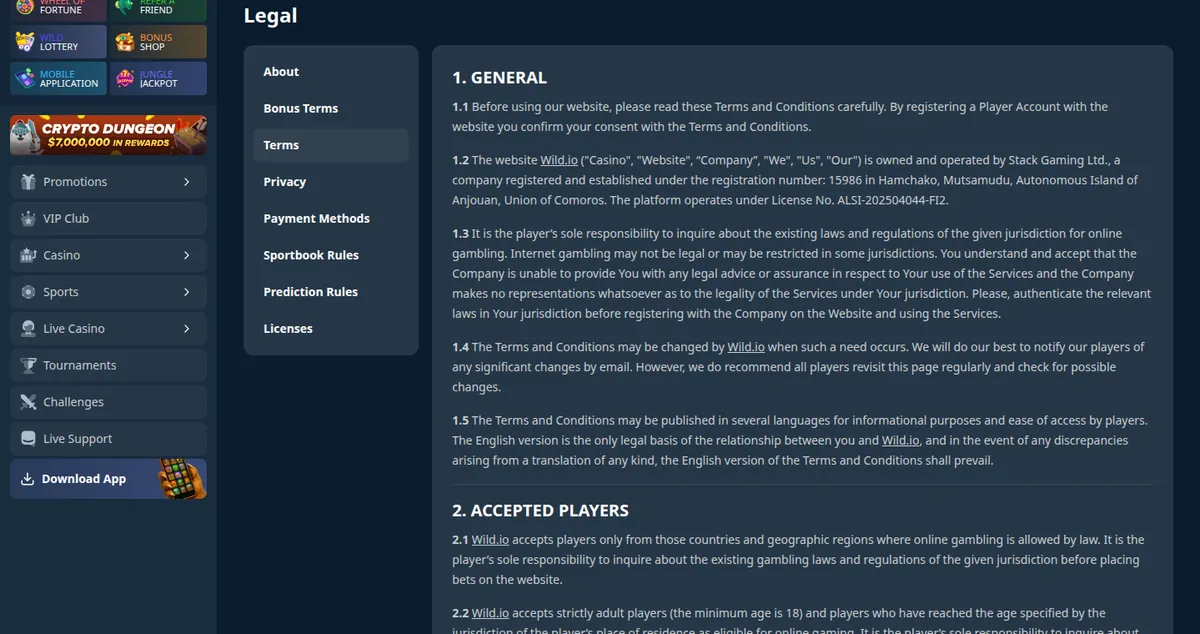
This is where the withdrawal cap of 100,000 USD per week in clause 9.6 comes from. We found the permit number OGL/2024/210/0198 in the Curaçao certificate register, and the company on the permit is Nonce Gaming B.V.
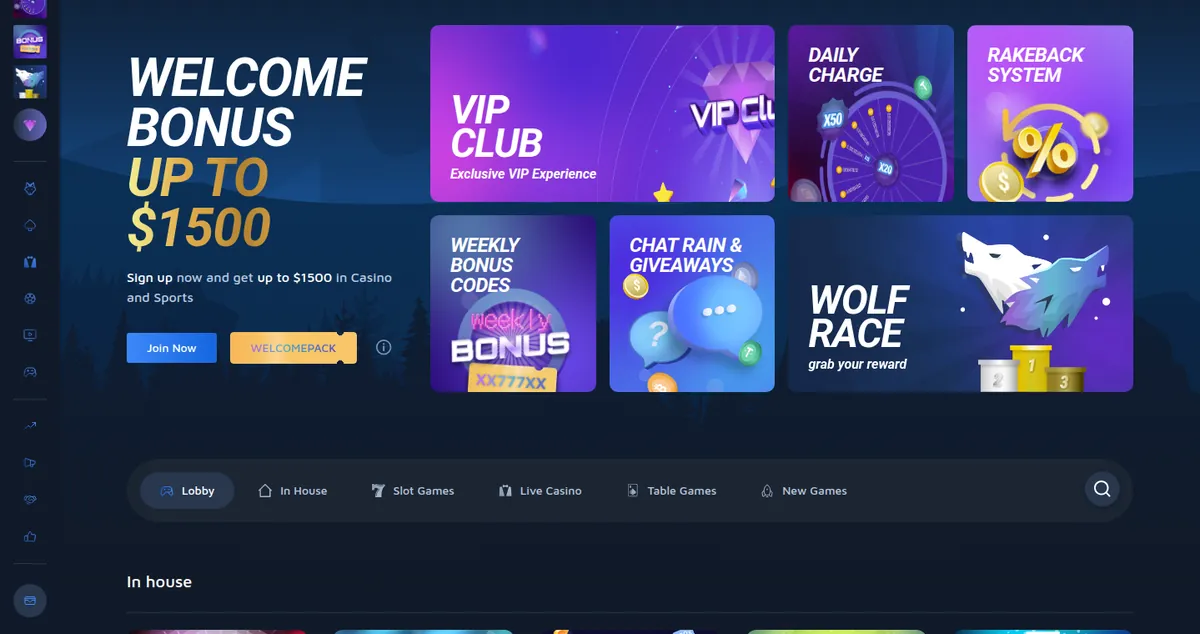
One of the two longest coin lists in the table: thirteen coins, with usdt and usdc among the six given prominence. We read the permit number ALSI-132405048-FI3 here, on the operator’s own page rather than in the Anjouan register; the company behind the brand is Cipher Games Ltd.
The issuer is called different things on different pages
The name of the supervisory authority varies within one and the same operator’s documents, and that is worth knowing before drawing conclusions from a name.
Wolf.bet’s responsible gambling page says the company is licensed and regulated in accordance with the standards of the Curaçao Gaming Authority, while the footer and the terms name Anjouan. Empire.io’s anti-money-laundering policy names the Anjouan Gaming Control Board as designated supervisory authority, while its licence pages say the Government of Anjouan. Metaspins calls the issuer the Anjouan Offshore Finance Authority in its terms and the government of the autonomous island of Anjouan in its footer.
We reproduce the issuer named in the register entry where one exists, and note the discrepancy rather than discarding it.
The issuer is written eight ways in the material
The variation above reaches beyond the ten rows. Across the whole collection of 100 operators, 67 name an issuer, and those 67 statements are written in eight different ways.
- Curaçao Gaming Authority — 36 times.
- Anjouan Gaming Board — 25 times.
- Antillephone N.V., Curaçao eGaming, Curacao, Government of Curaçao, Government of the Autonomous Island of Anjouan, Union of Comoros and one entry for Mwali — once each.
Forty statements therefore point to Curaçao, twenty-six to Anjouan and one to Mwali, but anyone searching for an authority name in plain text will miss a good many of them. A name falls short of an identifier in this material; the number is, and the register decides.
That is also why we avoid classifying an operator by what it calls its supervisory authority. Three of the ten in the table use different names on different pages of their own site, and a tally built on the names would count the same jurisdiction twice and miss the third.
The five jurisdictions named in the Anjouan terms
Anjouan’s standard conditions for its licensees name five jurisdictions as prohibited, on the ground that gambling there is reserved to a state monopoly: Austria, Germany, France, Spain and the Netherlands.
Sweden is absent from that list. That is a negative finding and therefore easy to overlook, but it is the most concrete piece of information we have about why these operators treat the Swedish and the German customer differently. We have read the standard conditions rather than every individual permit, and cannot therefore say whether any particular operator’s licence departs from the template.
Five of the ten in the table hold an Anjouan permit only, and their own country lists can be held against the list of five:
- Rainbet excludes eleven countries, and the five that lie within the EEA are exactly Austria, Germany, Spain, France and the Netherlands. Nothing beyond that.
- Wolf.bet and DuckDice name all five and further EEA countries besides.
- Wild Fortune names eleven EEA countries but only one of the five, the Netherlands.
- Empire.io names a single EEA country, Estonia, and therefore none of the five.
Two of the five lists therefore diverge from the enumeration their own permit rests on. That is an observation rather than an accusation: the lists are written for different purposes, one by the issuer and the other by the operator, and they may well differ in content. But for a customer in one of the five countries the difference is practical, because a dispute is brought against the operator under the licence whose conditions the issuer drafted. What the lists otherwise contain is on the page about offshore operators.
This is where the withdrawal cap of 100,000 USD per week in clause 9.6 comes from. We found the permit number OGL/2024/210/0198 in the Curaçao certificate register, and the company on the permit is Nonce Gaming B.V.
What a valid number actually covers
The permit says that an authority in that jurisdiction has assessed the business against its own rules. It says nothing about Swedish law: a permit from Curaçao leaves the gambling unlicensed under spellagen, and it leaves untouched who is covered by the exclusion register, which follows from the wording on the page about how far Spelpaus reaches.
It also says nothing about where a dispute goes. The counterparty to the contract is the company named on the licence, and that company sits in the issuer’s jurisdiction. Knowing the name is therefore the first practical value of a register hit; the second is that the terms you read belong with that name.
What the number says nothing about at all
It says nothing about the amount at which documents are requested, and nothing about how much may be withdrawn. Three of ten publish an amount and four a cap, and both items appear with clause numbers on the page about identity checks and withdrawals.
It says nothing about tax, which under 8 kap. 3 § of the Income Tax Act turns on where the gambling is provided rather than on where the permit was issued; the question is dealt with on the page about tax on winnings. A permit issued within the EEA would also fail to settle that question on its own, for reasons set out on the page about EU casinos without a Swedish licence.
And it says nothing about whether the operator is blocked in Sweden, since domain blocking is absent from Swedish law. What exists instead is on the page about what the statute says.
How to look the number up yourself
Start in the register rather than in the footer. The Curaçao certificate register is searched by the certificate’s own address and answers with number, company, status and date. The public Anjouan permit register lists number, company, issue date and validity period on the same row.
Then compare three fields against the terms: the number, the company name and the issuer’s name. It is the discrepancy between company names that is most useful, because the company name is who you are contracting with. One of the operators in the table, Empire.io, we could read only in an archived copy, and that qualification is set out on the page about how we read the documents.